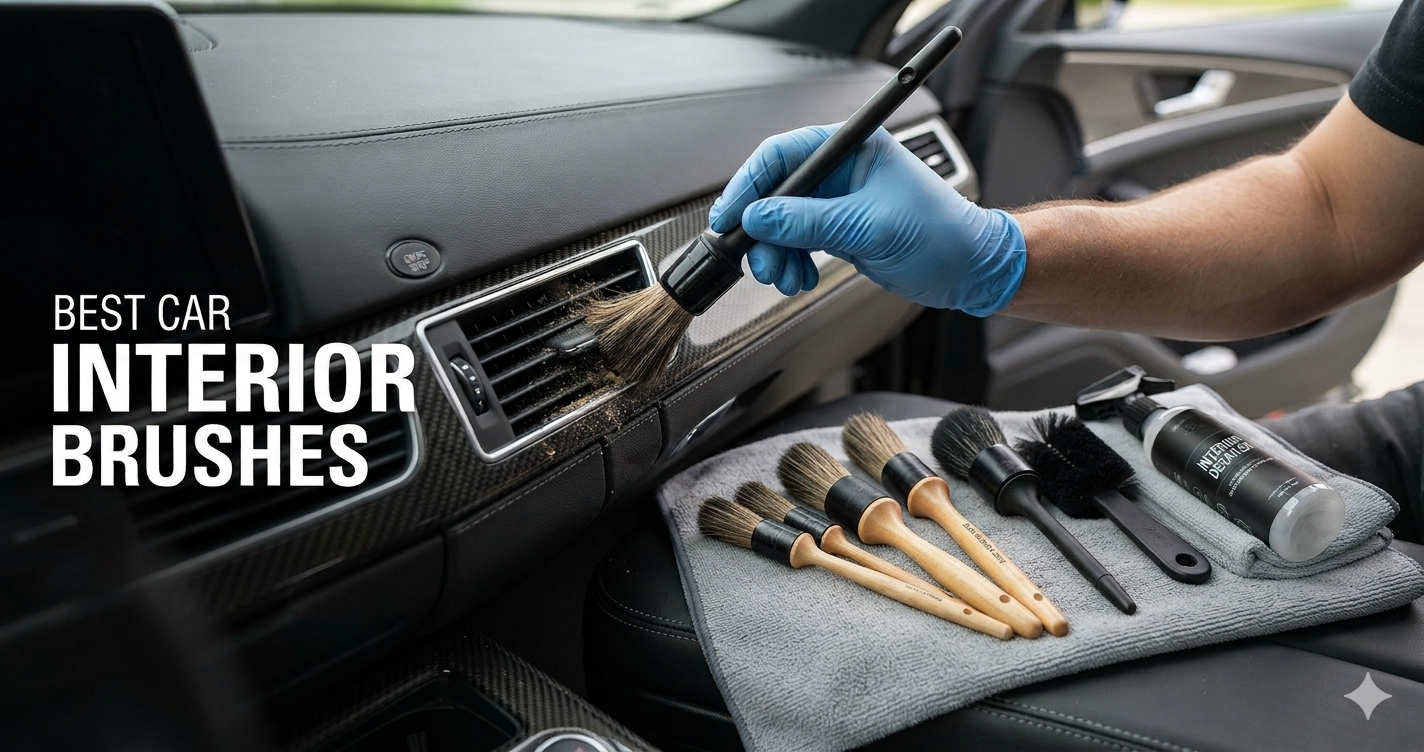
A microfiber towel and an all-purpose spray can only get you so far. The moment you try to clean an air vent, a seat seam, a cupholder, or the gap around your infotainment screen, a flat towel just can’t reach in. That’s where Best Car Interior Detailing Brushes earns its keep — it gets into the crevices, textures, and tight corners a towel slides right past.
Not every brush belongs in your car, though. The wrong bristle can scratch soft-touch plastic, dull a piano-black trim panel, or shed all over your freshly cleaned seats.
We looked at the most popular interior detailing brushes and brush sets on the market to find the ones that actually clean well without damaging anything — and put together a full buying guide so you know exactly which brush to grab for which job.
Who This Guide Is For
This guide is for anyone who wants to get past the surface-level clean a spray-and-wipe routine leaves behind — drivers tackling dusty air vents, crumb-packed seat seams, grimy cupholders, and the fine gaps around buttons and screens that a towel alone can’t touch.
Whether you’re doing a quick weekly refresh or a full seasonal detail, the right brush (or small set of brushes) makes the job faster and the result noticeably better.
Top picks of Best Car Interior Detailing Brushes
| Image | Product | Price |
|---|---|---|
 | Chemical Guys All in the Details Brush Set (3-Piece) Best Overall
| Price |
 | EZ Detail Brush Best for Vents
| Price |
 | Adam’s Polishes Double Sided Detailing Brush Best Dual-Sided
| Price |
 | Detail Factory Boar Hair Detailing Brush Best for Tough Grime
| Price |
 | Detail Factory Ultra-Soft Synthetic Brush Best for Screens & Piano Black
| Price |
 | Long-Handle Dash & Duster Brush Best for Dusting
| Price |
 | Multi-Piece Detail Brush Set (Budget Pack) Best Budget Set
| Price |
Best Car Interior Detailing Brushes at a Glance
Short on time? Here’s the quick answer. Each pick is explained in more detail further down the page.
1. Chemical Guys All in the Details Brush Set (3-Piece) — Best Overall
PROS
- Three sizes cover almost every interior surface, soft synthetic bristles are scratch-safe, well-built handles that hold up over time
CONS
- Priced as a set, so it’s not the cheapest option if you only need one brush
Best for: Drivers who want one complete, grab-and-go system for regular interior detailing.
This three-brush system is built around a simple idea: one brush can’t handle every surface in a cabin, but three well-chosen sizes can. The set covers a range from a small, precise brush for buttons, gauges, and stitched seams up to a larger brush for open surfaces like door panels and dash trim. All three use soft synthetic bristles, so you’re not risking a scratch on soft-touch plastic or a scuffed screen bezel.
It’s the kind of set you can keep in the car full-time and reach for constantly, whether you’re doing a five-minute touch-up or a full weekend detail. The only downside is that it’s sold as a set — if you only need one size, you’re paying for three.
2. EZ Detail Brush — Best for Vents
PROS
- Flexible handle bends to match vent angles, soft bristles won’t damage fins, genuinely solves a hard-to-clean spot
CONS
- Not designed for flat surfaces or general cleaning, so you’ll still want a second brush
Best for: Anyone whose dash vents collect a visible layer of dust between cleanings.
Air vents are one of the hardest spots in any car to actually clean — the angled slats trap dust, and a stiff, straight brush just bounces off them. This brush solves that with a long, flexible handle that bends to match the angle of vent fins, plus a soft bristle head that reaches deep into the fin without getting stuck.
It’s a specialist tool rather than an all-rounder, so it won’t replace a general detailing brush for flat surfaces or seams. But if dusty vents are your biggest pet peeve, nothing else on this list reaches into them as easily.
3. Adam’s Polishes Double Sided Detailing Brush — Best Dual-Sided
PROS
- Two bristle types in one tool, comfortable ergonomic handle, good value for the versatility
CONS
- Bulkier head than dedicated single-purpose brushes, less precise in the tightest gaps
Best for: Drivers who want one brush that can flex between light dusting and real scrubbing.
This brush puts two bristle types on one handle — a stiffer boar hair side for cutting through real grime, and a softer synthetic side for delicate trim and screens. Flipping between the two without switching tools makes it a genuinely efficient option when you’re moving between tougher and more delicate surfaces in the same session, like a dusty floor mat followed by a glossy trim panel.
The double-sided design does mean a slightly bulkier head than a single-purpose brush, which can make it a little less precise in very tight gaps. For general use, though, it’s one of the more versatile single-brush options available.
4. Detail Factory Boar Hair Detailing Brush — Best for Tough Grime
PROS
- Stronger scrubbing power than synthetic bristles, holds up well over repeated use, good for textured plastic and carpet
CONS
- Too stiff for glossy trim, screens, or delicate surfaces
Best for: Carpet, floor mats, and heavily soiled textured plastic that needs real scrubbing power.
When synthetic bristles aren’t cutting it, boar hair is the upgrade. It’s naturally stiffer and springier, which gives it more scrubbing power on textured interior plastics, floor mats, and carpet without being harsh enough to scratch most surfaces. It’s a favorite among long-time detailers for exactly that balance of strength and safety.
That extra stiffness is a double-edged sword — it’s not the brush you want anywhere near a glossy piano-black panel or a touchscreen, where a softer synthetic bristle is the safer call. Reserve this one for carpet, mats, and heavily textured plastic.
5. Detail Factory Ultra-Soft Synthetic Brush — Best for Screens & Piano Black
PROS
- Safe on scratch-prone gloss surfaces and screens, gentle enough for daily dusting, comfortable handle
CONS
- Not strong enough for real grime or heavily soiled areas
Best for: Piano-black trim, touchscreens, gauge clusters, and other easily scratched surfaces.
Modern interiors are full of surfaces that scratch easily — glossy piano-black trim, infotainment touchscreens, gauge clusters. This brush is built specifically for those spots, with bristles soft enough to dust and clean without leaving fine swirl marks behind, something a stiffer brush can absolutely cause on gloss finishes.
It’s intentionally a light-duty tool. Don’t expect it to cut through ground-in dirt or heavy grime — that’s not the job it’s designed for, and using it that way just means more passes for less result.
6. Long-Handle Dash & Duster Brush — Best for Dusting
PROS
- Long handle reaches across a full dashboard easily, very soft bristles, works without any spray or cleaner
CONS
- Dust-only — no use against grime, stains, or sticky spots
Best for: Quick, spray-free dust removal between deeper cleaning sessions.
For pure dust removal — the fine layer that settles on a dashboard, console, and vents between cleanings — a long-handled duster brush is hard to beat. The extended handle lets you reach across a wide dashboard without leaning awkwardly across the seats, and the soft bristles lift dust without needing any cleaning spray at all.
It’s a maintenance tool, not a cleaning one. It won’t touch actual stains, grime, or sticky residue, so treat it as the quick, five-minute option between real cleaning sessions.
7. Multi-Piece Detail Brush Set (Budget Pack) — Best Budget Set
PROS
- Very affordable way to cover multiple surfaces at once, good starting point for beginners
CONS
- Bristle and build quality varies more than single-purpose brushes; cheaper sets can shed
Best for: Anyone building their first car care kit who wants coverage without a big upfront cost.
If you’re just building out your car care kit and don’t want to buy specialty brushes one at a time, a budget multi-piece set is a practical starting point. These typically bundle several sizes and bristle types — a boar hair brush, a couple of soft synthetic brushes, and sometimes a small vent brush — for a fraction of what buying each separately would cost.
The trade-off with budget sets is consistency. Bristle quality and ferrule construction (the part that holds the bristles in the handle) vary more at this price point, and a poorly built ferrule is the main cause of shedding — loose bristles working free and embedding themselves in whatever you just cleaned.
Stick with sets from a recognized detailing brand rather than an unbranded bulk pack to avoid that headache.
Which Brush Works Best for Each Part of Your Car?
If you’d rather shop by problem area than by product name, here’s a quick reference for matching the right brush type to the most common trouble spots inside a car.
| Interior Zone | Recommended Brush Type | Why |
|---|---|---|
| Air vents | Long, flexible vent brush | Bends to match fin angle and reaches deep between slats |
| Piano-black trim & screens | Ultra-soft synthetic | Won’t scratch glossy or coated surfaces |
| Seat seams & stitching | Small, tapered synthetic | Precise enough to follow narrow stitch lines |
| Carpet & floor mats | Boar hair | Stiffer bristles lift embedded dirt from fibers |
| Dashboard & console (light dust) | Long-handle duster brush | Covers wide, open surfaces quickly without cleaner |
| Cupholders & vents corners | Mini crevice brush | Small head fits narrow, awkward gaps |
| Textured hard plastic trim | Boar hair or firm synthetic | Handles texture without needing excess scrubbing pressure |
How We Chose These Products?
We compared detailing brushes across the surfaces they’re actually used on in a typical interior — air vents, seat seams, cupholders, dashboard trim, carpet, and glossy or touch-sensitive panels like screens and piano-black finishes.
For each brush, we looked at bristle stiffness and material, whether the bristle-to-handle connection (the ferrule) was tight enough to resist shedding, handle comfort and length, and how well the design matched its intended surface.
We also weighed brand reputation and consistency, since ferrule construction and bristle quality are hard to judge from a product photo alone, and cross-referenced verified buyer feedback to see which brushes held up over repeated use rather than falling apart or shedding after a few wash cycles.
What Is a Car Interior Detailing Brush?
A detailing brush is a small, purpose-built brush designed to clean tight spaces and textured surfaces inside a car that a towel or cloth can’t reach effectively — air vent slats, seat seams and stitching, cupholders, buttons, gauge clusters, and the gaps around a center console or infotainment screen.
Unlike a general-purpose cleaning brush, detailing brushes are built with specific bristle materials and stiffness levels matched to automotive surfaces, so they clean effectively without scratching plastic, trim, or glass.
Detailing brushes typically fall into two bristle categories: boar hair, a natural, springy bristle known for stronger scrubbing power, and synthetic bristles (often nylon or a soft synthetic blend), which are gentler and safer for scratch-prone surfaces like screens and gloss trim. Some tools, like wire brushes, exist for automotive detailing too, but those are meant for exterior jobs like grilles and badges — never for interior surfaces.
How to Choose the Right Interior Detailing Brush?
Bristle Material: Boar Hair vs. Synthetic
This is the single biggest factor in choosing a brush. Boar hair bristles are stiffer and more abrasive, which makes them better at cutting through real grime on carpet, mats, and heavily textured plastic — but that same stiffness makes them risky on glossy or scratch-prone surfaces.
Synthetic bristles are softer and safer for screens, piano-black trim, and general dusting, but they won’t cut through tough, ground-in dirt as effectively. Most detailers end up owning at least one of each.
Brush Head Size and Shape
A small, tapered head gets into seat seams, buttons, and gauge clusters, while a larger, rounder head covers open surfaces like door panels and dashboards faster. A dedicated vent brush, with its long, narrow, often angled or flexible head, is built specifically to slide between vent fins that a standard brush head can’t reach.
Handle Length and Design
Short handles (around 5 to 7 inches) give you more control for detailed, close-up work, while longer handles help you reach across a wide dashboard or deep into a footwell without awkward angles. An ergonomic, textured grip matters more than it sounds — a slippery handle is genuinely harder to control once your hands are wet from cleaning spray.
Match Stiffness to the Surface
The general rule: the more delicate or glossy the surface, the softer the bristle should be. Use soft synthetic bristles on screens, piano-black trim, and soft-touch plastic. Save stiffer boar hair bristles for carpet, floor mats, and heavily textured, non-glossy plastic that can handle a bit more scrubbing pressure.
Ferrule Quality and Shedding Resistance
The ferrule is the metal or plastic band that holds the bristles into the handle, and it’s the single most common point of failure in cheap brushes.
A loose ferrule lets bristles work free after just a few uses, and those stray bristles can embed themselves in carpet or upholstery you just cleaned. Brushes from established detailing brands tend to use tighter, more durable ferrule construction than unbranded bulk packs.
Single Brush vs. Multi-Piece Set
If you only plan to tackle one or two trouble spots — like dusty vents — a single specialty brush is the more targeted (and often cheaper) choice. If you want to cover your whole interior with the right tool for every surface, a multi-piece set from a reputable brand is usually better value than buying several single brushes separately.
How to Use a Detailing Brush the Right Way
- Vacuum first. Clear loose dust and debris before brushing, so you’re not just pushing grit around the cabin.
- Match the brush to the surface. Soft synthetic bristles for screens and gloss trim, boar hair for carpet and textured plastic, a flexible vent brush for air vents.
- Apply cleaner to the surface, not the brush, for spray cleaning. A light mist on the surface (or a barely dampened brush) is usually enough — oversaturating a brush can push liquid into gaps you don’t want it in.
- Use short, controlled strokes. Long, heavy-handed sweeps are less effective than short, repeated strokes that work product into seams and texture.
- Work top-down. Clean higher surfaces like the dashboard and vents before seats and carpet, so loosened dust settles onto areas you’ll clean next, not ones you’ve already finished.
- Follow up with a microfiber towel. The brush loosens dirt; the towel lifts it away. Skipping this step just leaves loosened grime sitting on the surface.
- Rinse and dry the brush after use. Rinse bristles clean, gently squeeze out excess water, and hang the brush bristle-side down to dry so it keeps its shape.
Detailing Brush vs. Other Cleaning Tools
A brush isn’t a replacement for the rest of your cleaning kit — it fills a specific gap the other tools can’t:
- Vs. microfiber towels: Towels are best for flat, open surfaces. Brushes handle seams, vents, and textured or recessed areas a flat towel can’t get into.
- Vs. a vacuum with a crevice tool: A vacuum pulls loose debris out of gaps, but a brush is what actually loosens embedded dust and grime from textured surfaces before the vacuum (or a towel) removes it.
- Vs. compressed air: Canned or compressed air is great for blasting light dust out of vents, but it does nothing for sticky residue or ground-in dirt the way a brush and a bit of cleaner will.
- Vs. cotton swabs: Swabs work for single small spots but wear out fast and can leave fibers behind. A small detailing brush covers the same tight areas more efficiently and holds up to repeated use.
Common Mistakes to Avoid
- Using a stiff boar hair brush on glossy or soft-touch surfaces. This is the fastest way to create fine scratches or swirl marks on piano-black trim and screens.
- Scrubbing too hard. More pressure doesn’t mean a cleaner result — it just increases the risk of marring a surface. Let the bristles and a bit of cleaner do the work.
- Skipping the rinse-and-dry step. A brush left dirty and wet between uses breeds odor and can transfer old grime onto the next surface you clean.
- Using one brush for both interior and wheels. Brushes used on wheels pick up brake dust and grit that can scratch delicate interior surfaces — keep interior and exterior brushes clearly separate.
- Ignoring a shedding brush. If bristles are coming loose during use, stop — those stray bristles can embed in carpet or upholstery and are annoying to remove.
- Buying based on piece count alone. A 20-piece set with weak bristles and a loose ferrule is worse than a well-made 3-piece set — more brushes isn’t automatically better value.
- Storing brushes loose in a trunk or glovebox. Bristles bent out of shape from rattling around lose their effectiveness and are harder to control during use.
How to Care for Your Detailing Brushes
A good detailing brush can last for years with basic care. Rinse bristles thoroughly with clean water after every use to remove trapped dirt and cleaner residue, and gently squeeze out excess water rather than wringing or twisting the bristles, which can loosen them from the ferrule over time.
Hang brushes bristle-side down to dry so water drains away from the handle instead of soaking into it, and store them somewhere dry rather than tossed loose in a trunk where bristles can bend out of shape.
Frequently Asked Questions
What is the Best Brush for Cleaning Car Air Vents?
A dedicated vent brush with a long, flexible handle — like the EZ Detail Brush — is the best option, since it bends to match the angle of vent fins and reaches deep between the slats where a standard brush can’t.
Can I Use a Boar Hair Brush on my Dashboard?
It depends on the finish. Boar hair is safe on textured, matte plastic dashboards, but it’s too stiff for glossy piano-black trim or touchscreens, where a soft synthetic brush is the safer choice.
How Often Should I Use a Detailing Brush on My Car’s Interior?
A quick brush-down of vents, seams, and cupholders every couple of weeks keeps dust and debris from building up, while a full brush-assisted detail once a month or once a season handles deeper grime in carpet and upholstery.
Do Detailing Brushes Scratch Car Interiors?
They can, if you use the wrong bristle type on the wrong surface. Stiff boar hair bristles risk scratching glossy or soft-touch plastic, while soft synthetic bristles are safe on nearly every interior surface, including screens and gloss trim.
Are Detailing Brush Sets Better than Buying a Single Brush?
A set is better value if you plan to clean your entire interior regularly, since it gives you the right bristle type and size for each surface. A single brush makes more sense if you only need to solve one specific problem, like dusty vents.
How Do I Clean a Detailing Brush After use?
Rinse it thoroughly with clean water to remove trapped dirt and cleaner residue, gently squeeze out excess water without twisting the bristles, and hang it bristle-side down to dry completely before storing it.
What’s the Difference Between a Detailing Brush and a Paintbrush?
A detailing brush is purpose-built with automotive-safe bristle materials, ergonomic handles, and shapes designed for vents, seams, and trim. A standard paintbrush wasn’t engineered for this use — its bristles and ferrule aren’t built to handle repeated exposure to automotive cleaning chemicals, and it often lacks the shape needed to reach tight interior spots effectively.
Can I Use the Same Detailing Brush on Both My Car’s Interior and Exterior?
It’s best not to. Brushes used on wheels, tires, or engine bays pick up brake dust, grease, and grit that can scratch delicate interior surfaces if you switch to those tasks without a thorough cleaning first. Keeping a separate, clearly labeled brush (or color-coded set) for interior-only use avoids the risk entirely.
Do I Need a Boar Hair Brush if I Already have Synthetic Brushes?
Not necessarily, but it helps. Synthetic bristles handle the majority of interior surfaces safely, but they struggle against genuinely embedded dirt in carpet and heavily textured plastic. A single boar hair brush fills that gap without needing to replace your synthetic brushes for everyday use.
Final Verdict
For most drivers, the Chemical Guys All in the Details Brush Set is the smartest first purchase — three sizes of scratch-safe synthetic bristles cover almost everything you’ll run into during a routine clean. If dusty vents are your specific pain point, add the EZ Detail Brush to your kit.
And if your interior needs real scrubbing power on carpet or textured plastic, round things out with a Detail Factory Boar Hair Brush for the tougher jobs a synthetic bristle can’t handle alone.
However you build your kit, the goal is the same: match the bristle to the surface, and let the brush reach the spots your towel and vacuum leave behind.