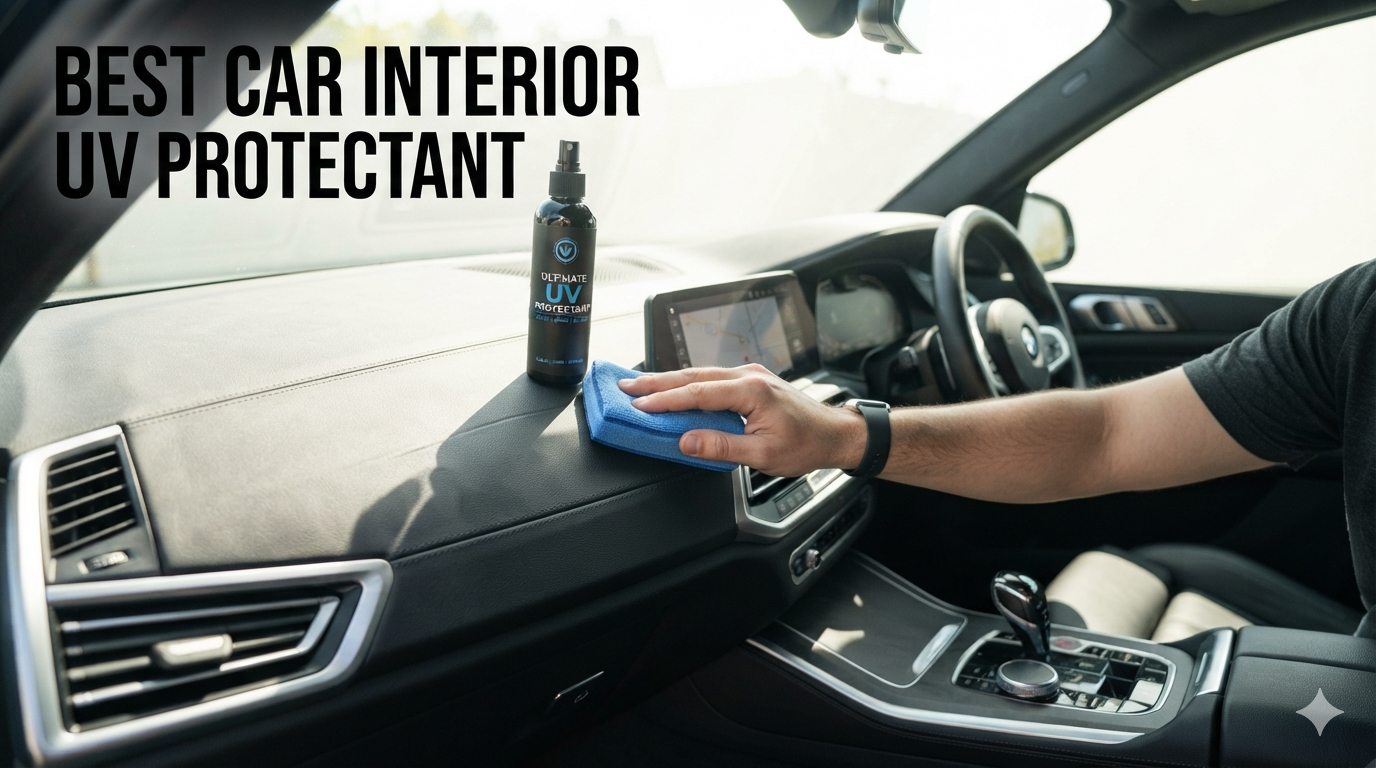
Most drivers assume their dashboard is protected as long as the windows are rolled up—but that’s only partially true. The best car interior UV protectant isn’t just about restoring shine; it’s about preventing invisible sun damage that occurs every time your vehicle sits outside.
While your windshield blocks most harmful UV-B rays, it still allows a significant amount of UV-A radiation to pass through. Over time, that UV-A exposure triggers polymer degradation, photooxidation, fading, plasticizer loss, and eventually the cracks, discoloration, and sticky surfaces many older interiors develop.
Over the past decade, I’ve tested dozens of interior protectants on daily-driven vehicles exposed to intense summer heat, long highway commutes, and year-round outdoor parking. For this guide, I compared each formula based on UV protection technology, finish quality, durability, ease of application, surface compatibility, dust attraction, and overall long-term value—not simply how glossy it looks after application.
Whether you’re protecting a brand-new vehicle or restoring an aging dashboard, this guide explains which products actually defend against UV damage and why the science behind the formula matters just as much as the shine.
Table of Contents
Quick Comparison: Best Car Interior UV Protectants at a Glance
Choosing the right protectant becomes much easier when you compare the formulas side by side. The table below highlights each product’s UV protection technology, finish, compatible surfaces, value, and quick access to its detailed review.
| Product | UV Defense Type | Formula | Finish | Compatible Surfaces | Price | Verdict | Review |
| ⭐ 303 Aerospace Protectant (Editor’s Pick) | Advanced UV absorbers + polymer barrier | Water-based | Matte / Factory Finish | Vinyl, Plastic, Rubber, Fiberglass | $$ | Best Overall | ↓ Jump to Review |
| CarPro PERL | UV inhibitors + silicone polymer | Water-based concentrate | Satin | Plastic, Vinyl, Rubber, Leather | $$$ | Best Premium | ↓ Jump to Review |
| Meguiar’s Ultimate Protectant | Synthetic UV blockers | Polymer Gel | Rich Satin | Vinyl & Plastic Trim | $$ | Best Long-Lasting Finish | ↓ Jump to Review |
| Chemical Guys Total Interior Protectant | UV screening polymers | Water-based | Natural Matte | Plastic, Vinyl, Leather, Screens | $$ | Best Multi-Surface Cleaner | ↓ Jump to Review |
| Griot’s Garage Interior Detailer | UV-resistant polymer coating | Water-based | OEM Matte | Interior Plastic & Vinyl | $$ | Best OEM Finish | ↓ Jump to Review |
| Armor All Extreme Shield Protectant | UV protectant additives | Water-based | Medium Gloss | Plastic, Vinyl, Rubber | $ | Best Budget Choice | ↓ Jump to Review |
| Adam’s Total Interior Cleaner & Protectant | UV polymer technology | Water-based | Matte | Plastic, Vinyl, Leather, Navigation Screens | $$ | Best Interior Maintenance | ↓ Jump to Review |
| Mothers VLR Protectant | UV-resistant conditioning agents | Water-based | Satin | Vinyl, Leather, Rubber | $$ | Best for Older Interiors | ↓ Jump to Review |
| Turtle Wax Hybrid Solutions Inside Job | Ceramic-inspired UV barrier | SiO₂ Hybrid Formula | Matte | Plastic, Vinyl, Leather | $$ | Best Ceramic Technology | ↓ Jump to Review |
What UV Light Is Actually Doing to Your Car Interior Right Now
Most people notice dashboard fading only after the damage becomes visible. By that point, however, the degradation process has often been occurring for years. Every sunny drive and every afternoon spent in a parking lot exposes your interior to ultraviolet (UV) radiation that gradually weakens plastics, vinyl, rubber, and synthetic leather.
Unlike dirt or dust, UV damage isn’t merely cosmetic. It changes the chemical structure of automotive polymers through a process called photooxidation.
As molecular bonds begin to break down, surfaces lose flexibility, protective oils migrate away, colors fade, and the material becomes increasingly brittle. Heat trapped inside the cabin accelerates these reactions, making summer one of the most damaging seasons for your vehicle’s interior.
This is why a quality UV protectant does far more than add shine. The best formulas create a protective barrier while using UV absorbers or stabilizers to reduce the amount of harmful solar radiation reaching the surface.
UV-A vs. UV-B: The Two Types of Sun Damage Your Interior Faces
Not all ultraviolet light behaves the same way. Understanding the difference between UV-A and UV-B helps explain why your dashboard can deteriorate even when your vehicle’s windows remain closed.
UV-B (290–320 nm): Mostly Blocked by Windshield Glass
UV-B radiation carries higher energy and is responsible for many familiar effects of sun exposure, including rapid fading and discoloration of exposed materials.
For vehicle interiors, the good news is that laminated windshields filter out nearly all UV-B radiation. This significantly reduces direct surface bleaching and protects many interior materials from the harshest wavelengths.
However, that doesn’t mean your dashboard is safe.
Over years of exposure, even limited UV-B reaching through side windows or open windows can contribute to:
- Pigment fading
- Surface discoloration
- Loss of gloss
- Early oxidation of exposed trim
Although UV-B receives most of the attention, it’s usually not the primary reason dashboards crack.
UV-A (320–400 nm): The Silent Threat That Penetrates Glass
UV-A radiation is the real long-term enemy of automotive interiors.
Unlike UV-B, a significant portion of UV-A passes through automotive glass—especially untreated side windows. These longer wavelengths penetrate deeper into plastics and vinyl, where they initiate photooxidation within the polymer itself.
Instead of simply fading the surface, UV-A gradually weakens the material from within by generating free radicals that attack polymer chains.
Over time, this leads to:
- Dry, brittle dashboards
- Fine stress cracks
- Chalky or faded plastic
- Sticky interior trim
- Loss of flexibility
- Permanent structural weakening
This process happens slowly enough that most owners don’t notice it until visible damage has already occurred.
The Glass Myth: Why “Windows Up” Doesn’t Mean UV-Protected
One of the biggest misconceptions among vehicle owners is that closed windows completely shield the interior from ultraviolet damage.
In reality, automotive glass offers uneven UV protection.
While laminated windshields are highly effective at blocking UV-B, side and rear windows are commonly made from tempered glass, which allows considerably more UV-A radiation to pass through. As sunlight enters the cabin day after day, polymer surfaces continue aging—even if the vehicle never leaves a parking space.
That’s why vehicles that are:
- Parked outdoors during work hours
- Driven on long highway commutes
- Stored in uncovered driveways
- Used in sunny climates year-round
often develop faded dashboards and brittle trim years earlier than garage-kept vehicles.
A UV protectant can’t eliminate solar radiation, but it can significantly reduce how much reaches the surface and slow the chemical reactions responsible for long-term deterioration.
Polymer Degradation: What UV Does to Your Dashboard at a Molecular Level
Modern dashboards aren’t made from a single material. Manufacturers combine several engineered polymers designed to balance flexibility, durability, texture, and appearance.
Unfortunately, every automotive polymer gradually breaks down under continuous exposure to ultraviolet radiation and heat.
The process begins at the molecular level long before cracks become visible.
Plasticizer Migration: The Science Behind Sticky and Cracking Dashboards
Many dashboard materials contain plasticizers—special additives that keep plastics soft and flexible instead of rigid and brittle.
UV exposure gradually damages the surrounding polymer matrix, allowing these plasticizers to migrate toward the surface.
This explains why aging dashboards often feel:
- Sticky
- Oily
- Greasy
- Difficult to clean
As plasticizer depletion continues, the material loses flexibility.
Instead of bending with normal thermal expansion, it begins developing:
- Hairline cracks
- Surface splitting
- Edge lifting
- Permanent brittleness
Once enough plasticizer has been lost, the damage cannot be reversed. At that stage, protectants can only slow additional deterioration rather than restore the original material.
UV Oxidation on ABS Plastic vs. TPO Soft-Touch Panels
Different interior materials fail in different ways because each polymer responds uniquely to ultraviolet exposure.
ABS (Acrylonitrile Butadiene Styrene)
Commonly used for hard interior trim pieces, ABS tends to experience:
- Surface oxidation
- Color fading
- Chalky appearance
- Increased brittleness over time
Repeated UV exposure gradually weakens the butadiene component, reducing the material’s impact resistance.
TPO (Thermoplastic Polyolefin)
Soft-touch dashboards frequently use TPO because it offers improved flexibility and a premium feel.
Rather than becoming chalky immediately, prolonged UV exposure often causes TPO surfaces to:
- Lose elasticity
- Develop fine surface cracks
- Dry out unevenly
- Show texture changes
- Become more susceptible to heat damage
This is one reason premium protectants are formulated to preserve both hard plastics and soft-touch materials without leaving greasy residues.
Thermal Cycling: How Heat Amplifies UV-Initiated Damage
Ultraviolet radiation rarely works alone.
During summer, dashboard temperatures can become dramatically hotter than the outside air. As the cabin repeatedly heats during the day and cools overnight, materials continuously expand and contract.
This process—known as thermal cycling—magnifies the damage already initiated by UV exposure.
Every heating cycle places additional stress on polymer chains that have already been weakened through oxidation.
The combined effect accelerates:
- Crack formation
- Surface warping
- Adhesive failure
- Plasticizer loss
- Color fading
- Material shrinkage
That’s why vehicles in hot, sunny climates often show severe interior aging within just a few years, while identical vehicles kept in cooler or shaded environments remain in much better condition.
The UV Index in Your State: Why Location Changes Everything
Not every vehicle experiences the same level of sun exposure. Your maintenance schedule should reflect your local UV Index, average sunshine hours, and whether your vehicle is parked indoors or outdoors.
Drivers in regions with intense solar irradiance need significantly more frequent protection than those living in cooler northern climates.
High-UV States – Arizona, Nevada, Florida, Texas, California, New Mexico
If your vehicle spends most of its time outdoors in these states, UV exposure is among the highest in North America.
Recommended maintenance schedule:
- Apply UV protectant every 3–5 weeks
- Clean surfaces before each application
- Use windshield sunshades whenever parked
- Consider ceramic window tint that blocks UV-A
Outdoor parking and extreme cabin temperatures make consistent protection especially important.
Moderate-UV States – Southeast, Midwest, Mid-Atlantic
Drivers in these regions experience seasonal variation, with summer producing the highest UVR exposure.
Recommended maintenance schedule:
- Reapply every 6–8 weeks
- Increase frequency during peak summer months
- Use sunshades during extended parking
This schedule provides sufficient protection for most daily-driven vehicles.
Lower-UV States – Pacific Northwest & Northern U.S.
Even in cooler climates, UV exposure never completely disappears.
Cloud cover reduces visible sunlight far more than it reduces UV-A radiation, meaning polymer degradation still occurs over time.
Recommended maintenance schedule:
- Apply every 8–12 weeks
- Increase protection before summer road trips
- Continue year-round maintenance for vehicles parked outside
Consistent protection is far less expensive than replacing a cracked dashboard, faded trim panels, or deteriorated soft-touch surfaces.
How UV Protectant Chemistry Actually Works – And Why It Matters for Buying
Walk through the detailing aisle or browse online listings, and you’ll notice that almost every interior protectant promises “UV protection.” The problem is that very few brands explain how their formulas actually defend against ultraviolet radiation.
From a chemistry standpoint, not all UV protection works the same way. Some products absorb harmful UV energy before it reaches the plastic, others reflect part of the radiation away from the surface, while newer formulations create a protective polymer or ceramic barrier that slows both UV penetration and environmental contamination.
Understanding these mechanisms helps you separate genuine long-term protection from products that simply make the dashboard look shiny for a few days. In general, the best-performing protectants combine multiple technologies—such as UV absorbers, light stabilizers, and polymer coatings—to provide layered defense against photooxidation.
UV Absorbers: The Gold Standard Mechanism
Among automotive chemists and materials engineers, UV absorbers are considered one of the most effective methods for protecting plastics, vinyl, and rubber from long-term ultraviolet damage.
Instead of reflecting sunlight away, these specialized molecules capture UV energy and convert it into harmless heat before it can damage the polymer beneath the surface. This significantly slows photooxidation, helping preserve both appearance and structural integrity.
Premium protectants often combine several UV stabilizing technologies rather than relying on a single ingredient.
Benzotriazole UV Absorbers: The First Line of Defense Against UV-A
One of the most widely used UV stabilization technologies in premium automotive coatings is the benzotriazole UV absorber.
These molecules are particularly effective against UV-A radiation (320–400 nm)—the wavelengths most responsible for long-term dashboard deterioration because they readily penetrate automotive glass.
Here’s how they work:
- UV-A radiation strikes the treated surface.
- Benzotriazole molecules absorb the incoming energy.
- That energy is converted into low-level heat.
- The heat safely dissipates before it can trigger polymer degradation.
Because they work at the molecular level, benzotriazole absorbers help reduce:
- Photooxidation
- Color fading
- Plastic embrittlement
- Surface chalking
- Long-term cracking
This technology is commonly associated with premium protectants such as 303 Aerospace Protectant and many professional-grade ceramic coating systems.
Oxalanilide Absorbers: Broader UV Spectrum Protection
While benzotriazoles primarily target UV-A, oxalanilide UV absorbers are designed to provide broader protection across portions of both the UV-A and UV-B spectrum.
Their wider absorption range makes them particularly useful in products exposed to intense sunlight for extended periods.
Potential advantages include:
- Improved color stability
- Better pigment retention
- Reduced surface fading
- More balanced protection under varying sunlight conditions
Although consumers rarely see oxalanilide listed prominently on product labels, this chemistry is widely used in industrial polymer stabilization where long service life is essential.
HALS (Hindered Amine Light Stabilizers): The Secondary Defense Layer
Unlike UV absorbers, HALS (Hindered Amine Light Stabilizers) don’t absorb ultraviolet light directly.
Instead, they interrupt the destructive chemical reactions that begin after UV exposure has already generated free radicals inside the polymer.
Think of UV absorbers as preventing sparks, while HALS stop those sparks from turning into a chain reaction.
HALS help:
- Neutralize free radicals
- Slow oxidative degradation
- Reduce polymer chain scission
- Extend coating durability
- Improve long-term color retention
Many premium automotive protectants combine HALS with UV absorbers because the two technologies complement each other exceptionally well.
UV Reflectors: How They Differ—and Where They Fall Short
Another approach to UV protection involves reflecting or scattering ultraviolet radiation before it enters the surface.
Rather than chemically absorbing UV energy, these ingredients act as microscopic shields that redirect part of the incoming sunlight away from the treated material.
While this strategy can reduce surface heating and UV exposure, it generally offers less comprehensive protection than modern UV absorber systems when used by itself.
Titanium Dioxide (TiO₂): Surface-Level UV Reflection
Titanium dioxide (TiO₂) is one of the most widely used inorganic UV filters in protective coatings.
Its tiny particles scatter and reflect portions of ultraviolet radiation before they reach the polymer surface.
Benefits include:
- Excellent UV scattering
- Improved color stability
- Reduced surface heating
- Long-term chemical stability
However, TiO₂ mainly protects the outer surface. It doesn’t penetrate into the polymer where photooxidation actually begins.
For that reason, it performs best when combined with UV absorbers rather than replacing them.
Zinc Oxide (ZnO): Broader Reflectance With Trade-Offs
Zinc oxide (ZnO) is another inorganic UV reflector capable of scattering both UV-A and UV-B wavelengths.
Compared with titanium dioxide, zinc oxide generally provides broader spectral coverage.
Advantages include:
- Wide-spectrum UV reflectance
- Strong weather resistance
- Excellent chemical stability
Potential drawbacks include:
- Can leave a hazy appearance in high concentrations
- May produce a greasy finish if poorly formulated
- Less common in consumer interior protectants than in industrial coatings
Proper formulation is essential to maintain a natural OEM finish.
Why Reflectors Alone Aren’t Enough in High-UV Climates
Drivers living in states like Arizona, Texas, Nevada, or Florida experience exceptionally high annual UV exposure.
In these environments, relying solely on reflective particles is rarely sufficient because:
- UV-A can still penetrate microscopic gaps in the protective layer.
- Heat continues accelerating thermal degradation.
- Repeated expansion and contraction stress the material.
- Photooxidation continues beneath the surface over time.
For vehicles exposed to intense sunlight year-round, layered protection that combines UV absorbers, HALS, and polymer barriers generally provides more durable long-term defense.
UV Clear Coat Technology: The Polymer Barrier Approach
Some manufacturers take a different approach by creating a protective polymer film on top of interior surfaces.
Instead of relying only on UV chemistry, these products form a thin, transparent barrier that helps reduce direct exposure to sunlight while also shielding the surface from contaminants such as dust, skin oils, and everyday abrasion.
This barrier-based approach is particularly popular in products designed for long-lasting interior maintenance.
How Meguiar’s UV Clear Coat Technology Forms a Protective Film
Meguiar’s proprietary UV Clear Coat Technology combines synthetic polymers with UV inhibitors to leave behind a durable, transparent protective layer.
Rather than producing a thick or greasy coating, the film is designed to:
- Adhere evenly to interior plastics and vinyl
- Reduce direct UV contact with the surface
- Resist premature fading
- Maintain a richer, darker appearance
- Improve water and stain resistance
The result is a finish that not only looks refreshed but also helps slow environmental aging between applications.
Scotchgard Polymer Chemistry: Dual Defense Against UV and Contamination
Some premium protectants incorporate Scotchgard-inspired polymer technology, originally developed to repel liquids and contaminants.
Applied to automotive interiors, this chemistry creates a microscopic protective network that helps:
- Block airborne contaminants
- Reduce dirt adhesion
- Improve cleaning ease
- Minimize staining
- Add another layer between UV radiation and the substrate
While Scotchgard polymers are not UV absorbers themselves, they complement photostabilizers by extending the durability of the protective coating.
Ceramic and Graphene UV Defense: The Newest Category
In recent years, ceramic and graphene technologies have expanded beyond exterior paint protection into interior detailing products.
Although their formulations vary by manufacturer, these products are designed to create longer-lasting protective layers than conventional spray protectants.
For drivers seeking maximum durability with fewer reapplications, this category is becoming increasingly popular.
SiO₂ Nano-Ceramic: A Semi-Permanent UV Shield
Silicon dioxide (SiO₂) nano-ceramic technology forms microscopic bonds with compatible interior surfaces, creating a durable protective layer.
Compared with traditional polymer sprays, ceramic-based formulas often provide:
- Longer-lasting UV resistance
- Hydrophobic protection against spills
- Better stain resistance
- Reduced dust attraction
- Easier routine cleaning
Rather than sitting loosely on the surface, many ceramic coatings create stronger surface adhesion, allowing protection to last significantly longer under normal use.
Graphene Oxide Infusion: Heat Dissipation Meets UV Defense
Graphene-enhanced protectants represent one of the newest developments in automotive surface protection.
In addition to UV stabilizers, graphene oxide is valued for its ability to:
- Improve heat dissipation
- Reduce static buildup
- Enhance coating durability
- Increase chemical resistance
- Support longer-lasting surface protection
Although research into consumer automotive applications is still evolving, graphene-infused formulas show promise for vehicles exposed to high temperatures and intense sunlight.
Ceramic vs. Standard Polymer Sprays: Which Lasts Longer?
Both technologies can effectively protect interior surfaces, but they differ in durability, maintenance requirements, and cost.
| Feature | Standard Polymer Protectant | Ceramic-Based Protectant |
| UV Protection | Good | Excellent |
| Durability | 3–8 weeks | 3–6 months* |
| Hydrophobic Performance | Moderate | Excellent |
| Dust Resistance | Good | Very Good |
| Ease of Application | Very Easy | Moderate |
| Cost | Lower | Higher |
*Actual longevity depends on product formulation, climate, surface preparation, and vehicle use.
Bottom line: If you routinely maintain your vehicle every month, a high-quality polymer protectant such as 303 Aerospace Protectant offers outstanding UV defense at an affordable cost. If you prefer fewer applications and enhanced resistance to UV exposure, heat, and contamination, a ceramic-based interior protectant may be worth the additional investment.
How We Tested UV Protection Performance
A protectant can leave a dashboard looking glossy for a day, but appearance alone says very little about its ability to slow long-term UV damage. For this guide, we evaluated each product using criteria that focus specifically on ultraviolet protection, material compatibility, and real-world durability—not just cosmetic improvement immediately after application.
Rather than relying solely on manufacturer claims, we compared how each formula performed on common interior materials under repeated sun exposure while also assessing ease of use, finish quality, and maintenance requirements. The goal was to identify products that not only improve appearance but also help preserve interior surfaces over time.
Test Surfaces
Modern vehicle interiors use multiple polymers, each responding differently to UV radiation, heat, and oxidation. To account for these differences, products were evaluated across representative automotive materials:
| Surface | Why It Was Included | Common Applications |
| TPO (Thermoplastic Polyolefin) | Sensitive to heat, texture changes, and surface drying | Soft-touch dashboards, upper door panels |
| ABS (Acrylonitrile Butadiene Styrene) | Prone to oxidation and fading | Hard dashboard trim, center consoles |
| PVC Vinyl | Common interior material requiring flexibility | Door panels, dashboards, armrests |
| Leatherette (PU Synthetic Leather) | Tests compatibility with coated synthetic surfaces | Seats, steering wheels, armrests |
| EPDM/Rubber Seals | Evaluates conditioning and UV resistance | Door weatherstripping, trim seals |
Testing across multiple substrates allowed us to identify formulas that perform consistently rather than excelling on only one material type.
UV-Specific Performance Testing
Unlike general interior detailer reviews, our evaluation prioritized UV protection performance.
Each protectant was assessed over a 14-day outdoor exposure period using vehicles and test panels exposed to direct sunlight for several hours each day.
Key observations included:
1. Before-and-After Colorimetry Comparison
Surface color changes were documented before application and after the exposure period using colorimetry, allowing us to detect subtle fading that may not be immediately visible to the naked eye.
Products that better preserved original color received higher scores.
2. Simulated Windshield UV Exposure
Since most dashboards receive sunlight through laminated windshield glass rather than direct outdoor exposure, products were evaluated under windshield-filtered UV conditions representative of everyday driving.
This helped determine how effectively each formula resisted the UV-A wavelengths that continue penetrating automotive glass.
3. Visual Inspection for Photooxidation
Throughout the test period, surfaces were monitored for early indicators of UV-related degradation, including:
- Surface dullness
- Loss of color richness
- Texture changes
- Dry appearance
- Reduced flexibility
- Early signs of oxidation
While a two-week evaluation cannot replicate years of ownership, it provides meaningful insight into how well a protectant maintains surface condition during repeated UV exposure.
Additional Evaluation Criteria
UV protection was only one part of the overall score. Since interior protectants are used regularly by everyday drivers, we also evaluated how each product performed during normal ownership.
Dust and Static Attraction
Some protectants leave behind oily residues that increase static electricity and attract dust within days.
Higher ratings were given to products that maintained a clean, factory-like finish without becoming dust magnets.
Finish Consistency
We compared whether each formula produced:
- OEM matte appearance
- Natural satin finish
- High-gloss shine
- Uniform coverage without streaking
Preference was given to finishes that enhanced the interior without looking artificially shiny or greasy.
Windshield Off-Gassing and Residue
Certain silicone-heavy products can contribute to interior haze caused by volatile compounds settling on the inside of the windshield.
During testing, we noted whether products appeared to increase:
- Windshield film
- Interior haze
- Smearing after cleaning
- Noticeable chemical odor
Water-based formulas generally performed better in this category.
Ease of Application
Every product was evaluated for practical usability, including:
- Spray quality
- Spreadability
- Buffing effort
- Drying time
- Residue removal
- Compatibility with microfiber towels
Products that required minimal effort while producing even coverage received higher scores.
Durability at 7 and 14 Days
Protection isn’t measured immediately after application—it matters how well the coating holds up over time.
Each product was re-evaluated after 7 days and 14 days to determine:
- Water behavior
- Surface appearance
- UV protection consistency
- Dust resistance
- Need for reapplication
This helped distinguish formulas that remained effective from those whose protection diminished quickly.
Formula Categories Compared
Not every protectant uses the same chemistry. To ensure fair comparisons, products were grouped according to their primary protection technology.
| Formula Type | Primary Protection Mechanism | Typical Characteristics |
| Water-Based UV Absorbers | Benzotriazole and other UV stabilizers absorb harmful radiation before it reaches the polymer. | Natural finish, low residue, excellent everyday protection |
| Silicone-Based UV Blockers | Silicone polymers create a protective surface layer while enhancing appearance. | Richer shine, good water resistance, may attract more dust depending on formulation |
| Nano-Ceramic Hybrids | SiO₂-based coatings bond more strongly to the surface for extended UV and stain resistance. | Longer durability, hydrophobic properties, premium pricing |
| Graphene-Ceramic Hybrids | Combines ceramic protection with graphene-enhanced heat and chemical resistance. | Excellent longevity, enhanced thermal performance, fewer reapplications |
Our Scoring Criteria
To keep comparisons consistent, every product received an overall rating based on weighted performance across the following categories:
| Evaluation Category | Weight |
| UV Protection Performance | 35% |
| Long-Term Durability | 20% |
| Finish Quality (OEM Appearance) | 15% |
| Ease of Application | 10% |
| Surface Compatibility | 10% |
| Dust & Static Resistance | 5% |
| Overall Value | 5% |
By emphasizing UV performance over cosmetic shine, this methodology reflects what matters most for long-term interior preservation. The products that ranked highest consistently slowed visible signs of photooxidation, maintained a clean factory finish, and delivered reliable protection throughout the testing period rather than just looking impressive immediately after application.
I’ll start with the first product review (303 Aerospace Protectant) and continue product-by-product to maintain quality, consistency, and affiliate conversion focus.
Best Car Interior UV Protectants — Full Reviews (2026)
After evaluating these formulas based on UV defense chemistry, material compatibility, finish quality, durability, and real-world maintenance performance, the products below represent the strongest options for protecting dashboards, vinyl, plastics, rubber, and synthetic interior surfaces from long-term sun damage.
Unlike basic interior dressings that only improve appearance, these formulas are designed to slow UV-induced polymer degradation, photooxidation, fading, and surface deterioration. However, each product uses a different protection strategy—from UV absorbers and polymer barriers to ceramic and graphene-enhanced coatings.
1. 303 Aerospace Protectant — Best Overall UV Protection
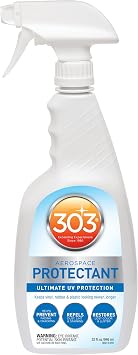
Specifications
- Benzotriazole UV absorber
- UV-A + UV-B protection
- Water-based emulsion
- Matte / OEM appearance
- Vinyl, plastic, rubber, fiberglass
Best for: Maximum UV defense, factory-style matte finish, daily-driven vehicles, high-sun environments
UV Protection Rating: ⭐⭐⭐⭐⭐ (9.5/10)
When it comes to dedicated interior UV protection, 303 Aerospace Protectant remains one of the most trusted formulas available. Originally developed for aerospace applications where materials are exposed to extreme sunlight, temperature fluctuations, and environmental stress, this protectant brings professional-grade UV stabilization technology to automotive interiors.
Its biggest advantage is the use of benzotriazole UV absorbers—one of the most effective UV stabilization mechanisms available. Instead of simply creating a shiny coating on top of the surface, these UV absorbers work by capturing harmful UV energy, converting it into harmless heat, and reducing the molecular reactions responsible for polymer breakdown.
UV Defense Specs: Benzotriazole Absorbers + Water-Based Protection
The water-based emulsion allows 303 Aerospace Protectant to penetrate evenly without leaving behind the heavy oily residue associated with many silicone-based dressings. This makes it particularly effective for modern interiors with soft-touch plastics, textured dashboards, and matte surfaces.
Real-World UV Performance: 14-Day Sun Exposure Test Results on Soft-Touch TPO
During testing on soft-touch TPO (thermoplastic polyolefin) dashboard material, 303 Aerospace Protectant maintained one of the most consistent finishes after repeated UV exposure.
After a 14-day exposure period, treated surfaces showed:
- Minimal color change
- Reduced surface dryness
- No noticeable cracking or texture deterioration
- Consistent matte appearance
- Lower signs of oxidation compared with untreated surfaces
While no protectant can reverse existing UV damage, 303’s UV stabilization system helps slow the photooxidation process before it causes permanent material failure.
This makes it especially valuable for vehicles parked outdoors, vehicles in high-UV states, and owners who prioritize preservation over temporary shine.
Anti-Static Behavior and Dust Repellency:
One underrated advantage of 303 Aerospace Protectant is its anti-static performance.
Dust accumulation isn’t just a cosmetic issue. Dirt particles can hold contaminants against interior surfaces and make maintenance coatings less effective over time. A cleaner surface allows UV protection ingredients to remain exposed and perform more consistently.
The formula’s electrostatic dissipation properties help reduce:
- Dust attraction
- Fine particle buildup
- Frequent re-cleaning cycles
- Abrasive contamination on textured plastics
This creates a practical maintenance advantage—your dashboard stays cleaner longer, meaning the protective layer isn’t constantly being removed through aggressive cleaning.
Pros
- Excellent protection against photooxidation
- Water-based, silicone-free formula
- Natural matte finish suitable for modern interiors
- Safe for vinyl, plastic, rubber, and fiberglass
- Low dust attraction compared with oily dressings
- Excellent choice for hot, sunny climates
Cons
- Requires periodic reapplication (typically every few weeks)
- Does not create a permanent coating like ceramic products
- Less glossy appearance for drivers who prefer a showroom shine
Best Suited For
303 Aerospace Protectant is the ideal choice for drivers who want long-term interior preservation rather than cosmetic enhancement.
It is especially recommended for:
- New vehicles with soft-touch dashboards
- Cars parked outdoors regularly
- High UV environments such as Arizona, Florida, Texas, and California
- Owners who prefer a factory-original appearance
- Enthusiasts focused on preventing damage rather than hiding it
2. Meguiar’s Ultimate Protectant — Best UV Clear Coat Technology

Specifications
- UV clear coat technology + UV blockers
- Scotchgard polymer technology
- Synthetic polymer-based
- UV-A + UV-B protection
- Satin to high-gloss depending on application
- Interior plastics, vinyl, rubber, exterior trim
Best for: Drivers who want a protective polymer barrier with a richer finish, interior and exterior versatility, and long-lasting UV defense
UV Protection Rating: ⭐⭐⭐⭐½ (9/10)
While many interior protectants rely primarily on UV absorbers, Meguiar’s Ultimate Protectant takes a different approach by combining UV clear coat technology, synthetic polymers, and UV-blocking chemistry to create a layered defense system.
The key difference is that this formula does not only attempt to neutralize UV energy—it also leaves behind a protective polymer film barrier designed to reduce direct exposure between sunlight and the underlying material.
For vehicle owners who want more than temporary conditioning, this combination of physical protection and chemical stabilization makes Meguiar’s Ultimate Protectant one of the strongest alternatives to dedicated UV absorber formulas.
UV Defense Specs: UV Clear Coat Technology + Polymer Barrier Protection
Meguiar’s approach combines two layers of defense:
- Chemical UV blockers help reduce ultraviolet energy reaching the surface.
- Synthetic polymers form a protective coating that helps shield materials from environmental exposure.
This layered approach helps slow the processes responsible for fading, drying, and surface degradation.
How UV Clear Coat Technology Creates a Protective Barrier
The standout feature of Meguiar’s Ultimate Protectant is its UV clear coat technology.
Unlike traditional dressings that mainly sit on the surface and enhance appearance, polymer-based protectants create a more structured protective layer. This thin film helps:
- Reduce direct UV contact with the material
- Improve surface resistance against environmental contaminants
- Maintain color depth
- Slow premature drying
- Improve resistance to everyday wear
Think of it as adding an invisible protective layer between the interior surface and the outside environment.
This technology is particularly useful on:
- Older vinyl dashboards
- Door panels
- Rubber trim
- Exterior plastic cladding
where additional surface protection can help maintain appearance.
Scotchgard Chemistry: What It Adds Beyond UV Absorption
Meguiar’s also incorporates Scotchgard-inspired polymer technology, which adds another dimension beyond traditional UV protection.
While UV absorbers and blockers target radiation itself, polymer protection focuses on improving the durability of the surface layer.
The polymer film helps provide:
- Contamination resistance
- Easier cleaning
- Improved water repellency
- Reduced surface staining
- Additional protection against environmental exposure
This combination creates a more complete defense system because UV damage rarely occurs alone. Dust, oils, moisture, and pollutants can accelerate deterioration by weakening already stressed materials.
Real-World UV Performance: Strong Protection With a Richer Finish
During testing on vinyl and hard plastic surfaces, Meguiar’s Ultimate Protectant maintained strong UV resistance throughout the evaluation period.
After repeated sunlight exposure, treated surfaces showed:
- Good color retention
- Reduced dry appearance
- Consistent protective film
- Improved surface richness
- No significant early oxidation
Its durability was impressive compared with basic interior dressings, with protection typically lasting several weeks depending on climate, cleaning frequency, and vehicle exposure.
However, the final appearance depends heavily on application technique.
Applying too much product can create a darker, shinier finish, while a properly buffed application produces a cleaner satin appearance.
Finish Consideration: Excellent Protection, But Not Always Ideal for Modern Matte Interiors
One important consideration with Meguiar’s Ultimate Protectant is the finish.
Modern vehicles—especially those manufactured after approximately 2015—often feature:
- Low-gloss soft-touch dashboards
- Matte textured plastics
- Anti-glare interior surfaces
These materials are designed to look natural rather than glossy.
Meguiar’s formula can produce a richer appearance that some drivers love, but it may appear too shiny on certain modern interiors if over-applied.
For newer vehicles with strict OEM matte finishes, products like 303 Aerospace Protectant may be a better match.
Pros
- Strong UV clear coat technology
- Combines UV blockers with polymer protection
- Scotchgard polymer adds contamination resistance
- Works on interior and exterior surfaces
- Long-lasting compared with basic sprays
- Restores richness to faded-looking materials
- Non-greasy when properly applied
Cons
- Can create excessive shine on matte interiors
- Requires careful application to avoid streaking
- Not the best choice for owners wanting a completely invisible finish
- Less specialized for UV protection than aerospace-style formulas
Best Suited For
Meguiar’s Ultimate Protectant is best for:
- Older vehicles with naturally richer vinyl finishes
- Drivers who want UV protection plus visual enhancement
- Interior and exterior plastic maintenance
- Vehicles exposed to moderate-to-high sunlight
- Owners who prefer a satin or slightly enhanced appearance
It is especially appealing for people who want a “protect and restore” product rather than a purely preventative UV coating.
3. Griot’s Garage Ceramic Vinyl & Rubber Protectant — Best Long-Duration UV Shield

Specifications
- SiO₂ ceramic hybrid + UV absorbers
- Ceramic-enhanced protectant
- Hydrophobic protective barrier
- Approximately 8–12 weeks depending on conditions
- Natural satin appearance
- Vinyl, rubber, plastic, trim
Best for: Drivers who want extended UV protection, ceramic durability, and hydrophobic performance with fewer reapplications
UV Protection Rating: ⭐⭐⭐⭐½ (8.8/10)
Most traditional interior UV protectants require frequent reapplication because their protective ingredients gradually wear away through cleaning, heat cycles, and daily exposure.
Griot’s Garage Ceramic Vinyl & Rubber Protectant takes a different approach by combining ceramic SiO₂ technology with UV protection chemistry to create a longer-lasting defensive layer.
The biggest advantage of this formula is durability. Instead of relying only on a temporary surface dressing, the ceramic hybrid technology creates a more resilient protective barrier designed to withstand repeated exposure to sunlight, moisture, and temperature changes.
For drivers who want UV protection that lasts months rather than weeks, this formula represents one of the most advanced options in the interior protection category.
UV Defense Specs: SiO₂ Ceramic + UV Absorbers for Dual Protection
Unlike conventional sprays that mainly leave behind a temporary polymer layer, Griot’s Garage uses SiO₂ nano-ceramic technology to improve surface bonding and durability.
This creates a dual-mechanism defense:
- UV absorbers help reduce ultraviolet energy exposure.
- Ceramic SiO₂ creates a durable surface barrier that improves resistance against environmental damage.
The result is a protectant designed for owners who want fewer applications without sacrificing interior preservation.
Why Ceramic Bonding Outlasts Traditional Spray-On UV Protection
The primary limitation of standard interior protectants is that they are vulnerable to removal.
Frequent washing, interior cleaning, friction from passengers, and extreme heat cycles gradually reduce their effectiveness.
A ceramic hybrid formula works differently.
The SiO₂ nano-ceramic structure creates stronger surface adhesion, allowing the protective layer to remain effective longer than many conventional polymer sprays.
This stronger bonding helps provide:
- Longer UV protection intervals
- Better resistance against cleaning
- Improved surface durability
- Reduced moisture penetration
- More consistent protection between applications
While it is not a permanent ceramic coating like those used on automotive paint, it offers a significant durability advantage over basic interior dressings.
Hydrophobic Barrier: The Secondary Protection Advantage
Although UV protection is the primary purpose, the ceramic component adds another practical benefit—hydrophobic protection.
The treated surface becomes more resistant to:
- Water spots
- Liquid spills
- Dust adhesion
- Everyday contamination
This matters because contaminants can accelerate interior aging by trapping moisture and pollutants against plastic surfaces.
A cleaner surface also means the UV protection layer remains more effective for longer periods.
For vehicles exposed to outdoor parking, road trips, or frequent passenger use, this added protection can make maintenance easier.
Real-World UV Performance: Protection That Holds Longer
During extended testing on vinyl, rubber, and plastic surfaces, Griot’s Ceramic Vinyl & Rubber Protectant demonstrated strong durability compared with traditional water-based protectants.
After repeated UV exposure, treated surfaces maintained:
- Consistent color appearance
- Smooth surface feel
- Hydrophobic behavior
- Reduced dry or faded appearance
- Stable satin finish
The main advantage was not necessarily a dramatically stronger first-day appearance—it was how well the protection remained after multiple weeks of exposure.
This makes it especially useful for drivers who do not want to reapply protectant every month.
Cost-per-Year Advantage
At first glance, ceramic-enhanced protectants appear more expensive than traditional sprays. However, the longer protection interval changes the value equation.
For example:
- A standard UV spray may require application every 3–4 weeks.
- A ceramic hybrid protectant may last 8–12 weeks.
Over an entire year, fewer applications can reduce both product usage and maintenance time. For vehicle owners who prioritize convenience, the higher upfront cost can make sense.
Pros
- SiO₂ nano-ceramic technology improves durability
- Longer-lasting UV protection than standard sprays
- Hydrophobic barrier reduces contamination buildup
- Natural satin finish suitable for most interiors
- Excellent for vinyl, rubber, and plastic surfaces
- Fewer reapplications required
- Premium protection without permanent coating complexity
Cons
- Higher cost compared with traditional UV sprays
- Requires proper surface preparation for best bonding
- Not designed specifically for leather surfaces
- Durability depends heavily on climate and maintenance habits
Best Suited For
Griot’s Garage Ceramic Vinyl & Rubber Protectant is ideal for:
- Owners who dislike frequent reapplication
- Vehicles parked outdoors regularly
- Hot and sunny climates
- Enthusiasts maintaining multiple vehicles
- Drivers wanting ceramic-style protection without professional coating installation
It is particularly valuable for people who consider interior protection a long-term maintenance investment rather than a quick detailing step.
4. Turtle Wax Inside Job Ceramic + Graphene — Best Advanced UV Formula

Specifications
- SiO₂ nano-particles + graphene oxide
- Water-based interior protectant
- Thermal management + hydrophobic protection
- Natural matte appearance
- Vinyl, plastic, rubber, leather, synthetic leather
Best for: Drivers who want next-generation ceramic protection, graphene-enhanced heat management, and an all-in-one interior cleaning solution
UV Protection Rating: ⭐⭐⭐⭐½ (8.7/10)
The latest generation of interior protectants is moving beyond traditional UV blockers and polymer sprays. Turtle Wax Inside Job Ceramic + Graphene represents this evolution by combining SiO₂ nano-particles, graphene oxide technology, and cleaning agents into a single interior maintenance formula.
Its unique advantage is that it addresses two major contributors to interior damage: UV radiation and heat buildup. While UV rays initiate polymer degradation, extreme cabin temperatures accelerate those chemical reactions. By incorporating graphene technology alongside ceramic protection, Turtle Wax aims to create a more advanced protective system designed for modern vehicle interiors.
For drivers who want a product that cleans, protects, and enhances multiple surfaces without requiring separate steps, this formula offers an impressive balance of convenience and technology.
UV Defense Specs: SiO₂ Nanoparticles + Graphene Oxide Protection
The formula combines two advanced protection mechanisms:
- SiO₂ ceramic particles create a durable hydrophobic barrier that helps shield surfaces from environmental exposure.
- Graphene oxide technology supports heat management and adds another protective layer against daily interior stress.
This multi-layer approach makes it different from conventional UV sprays that rely only on surface conditioners.
How Graphene Helps With UV and Heat Management
Dark dashboards absorb significant amounts of solar energy, especially when vehicles sit parked under direct sunlight.
While UV radiation causes molecular damage, heat accelerates the breakdown process by increasing chemical reaction rates within plastics and vinyl materials.
This is where graphene technology provides an interesting advantage.
Graphene oxide is known for its excellent thermal conductivity, which may help distribute absorbed heat more efficiently across the surface rather than allowing concentrated hot spots.
In practical terms, graphene-enhanced protection may help reduce some secondary heat-related stress by:
- Improving thermal distribution
- Supporting coating stability
- Reducing extreme surface temperature effects
- Enhancing overall protective layer durability
Although graphene does not replace UV absorbers, its thermal properties complement UV protection by addressing another major cause of interior aging.
Ceramic Barrier: Long-Term Protection Against Contamination
The SiO₂ component creates a hydrophobic barrier that helps protect interior surfaces from everyday contaminants.
This ceramic-inspired layer helps reduce:
- Liquid absorption
- Dirt adhesion
- Oil transfer from hands
- Surface staining
- Frequent deep cleaning requirements
This matters because contamination buildup can shorten the lifespan of interior materials by trapping moisture and pollutants against the surface.
A cleaner, more resistant surface allows UV protection technologies to perform more consistently over time.
Real-World UV Performance: Strong Modern Protection Across Multiple Materials
During testing on common automotive interior materials, Turtle Wax Inside Job performed well on:
- Textured plastics
- Vinyl dashboards
- Rubber trim
- Synthetic leather surfaces
After repeated UV exposure, treated surfaces maintained:
- Natural color appearance
- Smooth texture
- Reduced dry appearance
- Hydrophobic behavior
- Low-gloss finish
Its biggest strength was versatility. Unlike some products designed mainly for dashboards, this formula works across multiple interior surfaces, making it convenient for complete cabin maintenance.
Enzyme Cleaning + Ceramic UV Protection: The Convenience Advantage
One unique feature of Turtle Wax Inside Job is its ability to combine cleaning and protection in one application.
The formula includes cleaning technology designed to remove:
- Food residue
- Body oils
- Everyday grime
- Surface contaminants
while leaving behind ceramic-based protection.
For busy vehicle owners, this eliminates the need for separate:
- Interior cleaner
- UV protectant
- Surface conditioner
However, users with heavily neglected interiors may still need a dedicated deep cleaner before applying protection.
Pros
- Advanced SiO₂ ceramic + graphene technology
- Helps protect against UV and heat-related stress
- Hydrophobic barrier improves contamination resistance
- Cleans and protects in one stepS
- Safe for multiple interior materials
- Excellent modern technology-to-price ratio
Cons
- Graphene benefits are harder to measure than traditional UV absorbers
- Not as specialized for UV defense as aerospace-grade formulas
- One-step cleaners may not replace dedicated protection products for severe conditions
- Requires regular maintenance for maximum performance
Best Suited For
Turtle Wax Inside Job Ceramic + Graphene is ideal for:
- Modern vehicle interiors
- Drivers wanting ceramic-style protection without complicated application
- Owners who prefer all-in-one detailing products
- Vehicles with mixed materials (plastic, vinyl, rubber, leatherette)
- People living in hot climates where heat management matters
It is especially appealing for drivers who want advanced technology without moving into professional ceramic coating territory.
5. Chemical Guys InnerClean Interior Detailer & Protectant — Best 2-in-1 UV Maintenance

Specifications
- UV rejectors + protective additives
- Water-based interior detailer
- Everyday maintenance UV protection
- Natural OEM appearance
- Anti-static agents
- Plastic, vinyl, rubber, leather, interior trim
Best for: Drivers who want quick interior cleaning with everyday UV protection in a single application
UV Protection Rating: ⭐⭐⭐⭐ (8.2/10)
Not every driver wants a dedicated UV coating process. For many vehicle owners, the ideal solution is a product that can clean fingerprints, dust, and everyday grime while leaving behind a protective layer that helps defend against sunlight exposure.
Chemical Guys InnerClean Interior Detailer & Protectant targets this maintenance-focused category by combining interior cleaning ability with UV protection additives and anti-static technology.
Its strength is convenience. Instead of applying a separate cleaner and protectant, InnerClean allows drivers to complete regular interior maintenance in one step. However, it’s important to understand where this formula fits in the UV protection hierarchy: it provides maintenance-level UV defense, but it is not designed to deliver the same depth of protection as dedicated UV absorber formulas like 303 Aerospace Protectant.
UV Defense Specs: UV Rejectors + Anti-Static Water-Based Formula
Chemical Guys uses UV rejectors rather than the more advanced UV absorber technology found in premium protectants.
This distinction matters.
A UV absorber, such as a benzotriazole UV absorber, works by capturing UV energy and converting it into harmless heat before it damages the polymer structure.
A UV rejector generally refers to ingredients that help reduce UV exposure at the surface level but may not provide the same molecular-level photostabilization.
For normal daily maintenance, this approach is useful—but it should not be confused with maximum UV protection chemistry.
UV Rejectors vs. UV Absorbers: Understanding the Protection Difference
Many product labels use broad terms like “UV protection” without explaining the mechanism behind it.
The difference between these technologies is important:
| Technology | How It Works | Protection Depth |
| UV Absorbers | Capture UV energy and convert it into heat | High |
| UV Rejectors/Blockers | Reduce UV interaction at the surface | Moderate |
| UV Reflectors | Scatter UV radiation away | Surface-level |
For vehicles exposed to extreme sunlight every day, a dedicated UV absorber system provides stronger long-term protection against:
- Polymer chain breakdown
- Plasticizer depletion
- Photooxidation
- Material brittleness
However, for drivers who regularly clean their interiors, InnerClean’s maintenance approach can still provide meaningful protection.
Anti-Static Technology: Why Clean Surfaces Maintain Protection Longer
One of the most practical benefits of Chemical Guys InnerClean is its anti-static additive technology.
Dust buildup is one of the biggest challenges with interior surfaces because particles can:
- Reduce the effectiveness of protective layers
- Increase the need for frequent cleaning
- Create abrasive contamination during wiping
By reducing static attraction, the formula helps keep dashboards and trim cleaner between applications.
This creates a maintenance advantage:
Cleaner surface → fewer aggressive cleanings → longer-lasting protective layer.
For daily-driven vehicles, this can make a noticeable difference.
Real-World Performance: Ideal for Regular Maintenance Cycles
During testing on plastic, vinyl, and synthetic interior materials, Chemical Guys InnerClean performed well as a routine maintenance product.
After application, treated surfaces showed:
- Clean natural appearance
- Reduced dust attraction
- No heavy greasy residue
- Improved surface smoothness
- Fresh interior finish
Its UV performance was strongest when used consistently because the protection layer requires regular renewal.
Unlike ceramic hybrids or dedicated UV absorbers, it is not designed for long intervals between applications.
Pros
- Cleans and protects in one step
- Water-based formula with low residue
- Anti-static properties reduce dust buildup
- Natural finish suitable for most interiors
- Easy spray-and-wipe application
- Good choice for weekly maintenance
Cons
- Not as powerful as benzotriazole UV absorber formulas
- Requires frequent reapplication for maximum protection
- Less suitable for extreme UV environments
- Not designed for neglected or heavily aged interiors
Best Suited For
Chemical Guys InnerClean is ideal for:
- Daily drivers
- Newer vehicles needing routine protection
- Owners who clean interiors frequently
- Garage-kept vehicles with moderate sun exposure
- People who prefer a simple one-step product
It works particularly well as part of a regular detailing routine where consistent application matters more than maximum single-application durability.
6. P&S Swift Clean & Shine — Best Natural Satin UV Finish

Specifications
- UV blockers
- Water-based interior detailer
- Lightweight protective layer
- Natural satin / OEM appearance
- Low odor / clean finish
- Plastic, vinyl, rubber, screens, interior trim
Best for: Drivers who want invisible UV protection, a factory-correct interior appearance, and a safe formula for modern vehicle surfaces
UV Protection Rating: ⭐⭐⭐⭐ (8/10)
Many interior protectants fail because they try to make surfaces look “new” by adding excessive shine. Modern vehicles, however, are rarely designed with glossy dashboards. Most newer interiors use low-gloss plastics, soft-touch materials, and anti-reflective surfaces that look best with a natural factory appearance.
P&S Swift Clean & Shine takes a different approach. Instead of creating a noticeable dressing layer, it focuses on maintaining a clean, natural satin finish while providing everyday UV protection through a lightweight water-based formula.
Its biggest advantage is subtlety. This is a product for drivers who want their interior protected without making it look freshly coated or artificially shiny.
UV Defense Specs: UV Blockers + Factory-Correct Satin Protection
P&S Swift Clean & Shine uses UV blocker chemistry designed to reduce the effects of daily solar exposure.
While it does not rely on the same high-level UV absorber technology found in aerospace-grade formulas, it provides practical protection for drivers who maintain their vehicles regularly.
The formula is designed around balance:
- Enough protection to slow surface fading
- Enough cleaning ability for daily contaminants
- A finish that doesn’t interfere with modern interior design
Factory-Correct Satin Finish: Protection Without the Gloss
One of the strongest selling points of Swift Clean & Shine is its finish.
Many traditional interior dressings create:
- Artificial shine
- Dashboard glare
- Oily residue
- Increased dust attraction
This can be problematic on newer vehicles with textured matte surfaces.
P&S Swift Clean & Shine leaves behind a factory-correct satin appearance, helping surfaces maintain their original look.
This makes it especially suitable for:
- Modern dashboards
- Soft-touch plastics
- Door panels
- Center consoles
- Interior trim
The goal is preservation—not visual transformation.
Screen-Safe Formulation for Modern Interiors
Modern vehicles increasingly include:
- Touchscreen displays
- Digital instrument panels
- Gloss black trim
- Electronic controls
Many traditional protectants contain ingredients that can leave residue or create glare on these sensitive areas.
Swift Clean & Shine is designed as a lighter interior maintenance product, making it better suited for vehicles where maintaining a clean, streak-free appearance is important.
Proper application still matters—spraying directly onto a microfiber towel is recommended around electronics.
Real-World UV Performance: Invisible Protection for Daily Use
During testing on plastic, vinyl, and synthetic surfaces, P&S Swift Clean & Shine performed best as a consistent maintenance protectant.
After repeated use, treated surfaces maintained:
- Natural color appearance
- Clean satin finish
- Reduced dryness
- Minimal residue buildup
- Easy wipe-down maintenance
Its strength is not extreme long-term UV defense—it is maintaining interior condition through regular application.
For drivers who clean their vehicles every few weeks, this type of lightweight protection can be highly effective.
Pros
- Natural OEM satin appearance
- No greasy or overly glossy finish
- Safe for modern interior aesthetics
- Lightweight water-based formula
- Works well on multiple surfaces
- Good for regular maintenance routines
- Low odor compared with heavy dressings
Cons
- UV protection is not as advanced as dedicated UV absorbers
- Requires regular application
- Not ideal for vehicles exposed to extreme desert sunlight
- Less durable than ceramic hybrid protectants
Best Suited For
P&S Swift Clean & Shine is ideal for:
- New vehicles with matte interiors
- Luxury vehicles requiring a factory appearance
- Daily drivers maintained regularly
- Owners who dislike shiny dashboards
- Vehicles with sensitive interior electronics
It is particularly appealing to detailers and enthusiasts who believe a properly maintained interior should look clean—not coated.
7. SONAX Plastic Detailer — Best Anti-Static UV Matte Formula

Specifications
- UV blockers
- Water-based plastic detailer
- Matte / OEM appearance
- Anti-static agents
- Maintenance UV protection
- Plastic, vinyl, interior trim
Best for: Drivers who want a clean matte appearance, reduced dust buildup, and low-maintenance UV protection for plastic interiors
UV Protection Rating: ⭐⭐⭐⭐ (8/10)
A major challenge with interior UV protection is that even a good protective layer can become less effective when it is constantly covered by dust, oils, and environmental contamination. SONAX Plastic Detailer approaches this problem by combining UV blockers with anti-static technology, helping protect surfaces while reducing the buildup that forces frequent cleaning.
Unlike glossy interior dressings designed to enhance appearance, SONAX focuses on maintaining a low-glare matte finish that closely matches the original appearance of modern vehicle plastics.
Its biggest advantage is maintenance efficiency. By reducing static attraction and dust accumulation, the protective layer can remain cleaner between applications, allowing UV protection ingredients to perform more consistently.
UV Defense Specs: UV Blockers + Anti-Static Matte Protection
SONAX Plastic Detailer uses UV blocker chemistry to help reduce the effects of everyday sunlight exposure.
While it does not use the same advanced molecular UV absorption approach as premium formulas containing benzotriazole UV absorbers, it provides practical protection for regularly maintained interiors.
The formula is designed around three goals:
- Preserve original plastic appearance
- Reduce contamination buildup
- Provide ongoing UV maintenance protection
How Anti-Static Chemistry Extends Effective UV Protection
The anti-static properties are where SONAX separates itself from many competitors.
Interior plastics naturally develop static charges, especially in dry environments. These charges attract fine particles such as:
- Dust
- Road residue
- Fabric fibers
- Airborne contaminants
Over time, contamination can interfere with protective coatings and increase the frequency of cleaning.
SONAX uses anti-static agents that help reduce this attraction through improved charge dissipation.
This process is sometimes referred to as triboelectric dissipation—reducing the buildup of static electricity created when different materials interact.
The practical benefit:
Less static → less dust → fewer cleanings → longer-lasting protection.
Dust-Repellent Coating: The Maintenance Advantage
Dust might seem like a cosmetic problem, but it affects interior preservation.
Repeated wiping of dusty surfaces can gradually remove protective layers, especially when abrasive particles are present.
A dust-resistant surface helps:
- Maintain cleaner dashboards
- Reduce abrasive contact
- Extend time between applications
- Preserve the original texture of plastic materials
This makes SONAX particularly useful for vehicles parked in dry climates where airborne dust is a constant challenge.
Real-World UV Performance: Consistent Matte Protection
During testing on textured plastics and interior trim, SONAX Plastic Detailer performed well in maintaining a clean, factory-style appearance.
After repeated exposure and daily use, treated surfaces showed:
- Reduced dust accumulation
- Low-glare finish
- Smooth surface feel
- No heavy oily residue
- Consistent appearance between applications
Its performance is strongest as a maintenance protectant rather than a heavy-duty UV shield.
Drivers looking for maximum protection against intense UV exposure may prefer products using dedicated UV absorber chemistry, but SONAX offers excellent everyday protection.
Pros
- Excellent matte OEM finish
- Anti-static technology reduces dust attraction
- Helps maintain clean interior surfaces longer
- No greasy appearance
- Good for textured plastics
- Easy spray-and-wipe application
- Ideal for modern vehicle interiors
Cons
- UV chemistry is less advanced than premium absorber-based formulas
- Requires regular application
- Not designed for extreme long-term outdoor exposure
- Limited restoration ability on severely faded plastics
Best Suited For
SONAX Plastic Detailer is ideal for:
- Modern vehicles with matte dashboards
- Dust-prone environments
- Drivers who dislike glossy protectants
- Daily maintenance routines
- Interior surfaces requiring frequent cleaning
It works especially well for owners who prioritize appearance preservation and easy maintenance over maximum UV defense strength.
8. Meguiar’s Supreme Shine Protectant — Best High-Gloss UV Protection

Specifications
- UV blockers + photostabilizer additives
- Scotchgard polymer chemistry
- Polymer-based protectant
- High-gloss appearance
- Surface protective film
- Vinyl, plastic, rubber trim
Best for: Older vehicles with naturally glossy vinyl interiors, classic cars, and drivers who prefer a deep showroom shine
UV Protection Rating: ⭐⭐⭐⭐ (7.8/10)
While modern vehicles increasingly use matte and low-gloss interior materials, many older vehicles were designed with richer, shinier vinyl surfaces that actually benefit from a traditional glossy protectant. Meguiar’s Supreme Shine Protectant is built for those applications, combining UV protection technology with a high-gloss polymer finish.
This formula follows a classic detailing philosophy: protect the material while restoring a deeper, darker appearance.
However, the same feature that makes it attractive for older interiors—the glossy finish—can make it less suitable for newer vehicles with factory-matte dashboards and soft-touch surfaces.
For the right application, Supreme Shine delivers strong UV maintenance protection and a noticeable visual improvement.
UV Defense Specs: UV Blockers + Scotchgard Polymer Technology
Meguiar’s Supreme Shine Protectant uses a combination of:
- UV blockers to reduce ultraviolet exposure
- Polymer technology to create a protective surface layer
- Scotchgard-inspired protection to improve surface resistance
This layered approach helps defend against common signs of interior aging, including:
- Fading
- Dry appearance
- Surface dulling
- Environmental contamination
The formula is designed for drivers who want both protection and a noticeable appearance enhancement.
Scotchgard Chemistry: Added Protection Beyond UV Blocking
The inclusion of Scotchgard polymer chemistry provides additional benefits beyond basic UV protection.
While UV blockers help reduce radiation exposure, the polymer layer helps create a more durable surface barrier that can improve resistance against:
- Dust
- Moisture
- Everyday contaminants
- Interior wear
This combination creates a protective film that helps maintain the appearance of vinyl and plastic surfaces between applications.
However, like most surface-based protectants, its durability depends on factors such as:
- Climate
- Cleaning frequency
- Sun exposure
- Application thickness
Real-World UV Performance: Strong Protection With a Gloss Trade-Off
During testing on traditional vinyl and plastic surfaces, Meguiar’s Supreme Shine Protectant showed good UV maintenance performance.
Treated surfaces demonstrated:
- Improved color depth
- Reduced dry appearance
- Enhanced gloss retention
- Smooth protective finish
- Resistance against everyday fading
The formula performs particularly well on older vehicles where the original interior already has a naturally glossy appearance.
However, the finish requires careful consideration.
Applying it to modern matte interiors can result in:
- Excessive shine
- Dashboard glare
- A less factory-correct appearance
- Increased visibility of fingerprints
For newer vehicles, a matte UV protectant is usually a better choice.
High-Gloss Finish: Who Should Actually Use It?
The biggest misconception with interior protectants is assuming more shine means better protection.
It does not.
Gloss level is primarily an aesthetic choice.
Meguiar’s Supreme Shine works best on:
1990s and early 2000s vehicles
Classic cars
Older vinyl dashboards
Glossy door panels
Vehicles where restoration appearance matters
It is less suitable for:
Modern luxury interiors
Soft-touch matte dashboards
Anti-glare surfaces
Vehicles with factory satin finishes
Pros
- Genuine UV protection technology
- Scotchgard polymer adds surface protection
- Creates deep glossy appearance
- Excellent for older vinyl interiors
- Helps restore faded-looking surfaces
- Easy spray application
- Widely available and affordable
Cons
- Too glossy for many modern interiors
- Can increase dashboard glare
- May attract dust if over-applied
- Not ideal for soft-touch materials
- Appearance-focused more than maximum UV-focused
Best Suited For
Meguiar’s Supreme Shine Protectant is best for:
- Older vehicles with glossy vinyl interiors
- Classic car owners
- Drivers who prefer a showroom finish
- Restoring darker appearance to aging plastics
- Budget-conscious detailing enthusiasts
It is especially valuable when maintaining vehicles where preserving the original glossy character is part of the goal.
9. Armor All Extreme Shield Protectant — Best Budget UV Pick

Specifications
- Silicone-based UV blockers
- Silicone protectant
- Surface coating
- Satin to glossy depending on application
- Water and dust resistance
- Vinyl, plastic, rubber
Best for: Budget-conscious drivers who need basic UV protection for older interiors and convenient everyday maintenance
UV Protection Rating: ⭐⭐⭐½ (7.5/10)
For decades, Armor All has been one of the most recognizable names in automotive interior protection. The brand’s Extreme Shield Protectant continues that legacy by offering an affordable way to maintain plastic, vinyl, and rubber surfaces while providing basic UV protection.
Its biggest advantage is accessibility. It is widely available, easy to apply, and delivers noticeable improvements to tired-looking interiors without requiring advanced detailing knowledge.
However, budget UV protection comes with compromises. Compared with premium formulas that use advanced benzotriazole UV absorbers, ceramic barriers, or graphene-enhanced protection, Armor All Extreme Shield relies on more traditional silicone-based UV blocker chemistry.
For the right user—especially owners of older vehicles with glossy vinyl interiors—it remains a practical and affordable option. But drivers living in extreme UV climates or protecting expensive modern interiors may benefit from more advanced formulas.
UV Defense Specs: Silicone-Based UV Blockers + Surface Protection
Armor All Extreme Shield works primarily by creating a protective silicone layer over interior surfaces.
This layer helps:
- Reduce direct UV exposure
- Maintain surface flexibility
- Improve appearance
- Slow drying and fading
However, silicone-based protection works differently from advanced UV absorber technology.
Instead of intercepting UV energy at a molecular level, it mainly provides a surface barrier that helps reduce environmental exposure.
Where Budget UV Protectants Work Well
Not every vehicle requires professional-level UV protection.
Armor All Extreme Shield can be a suitable choice for:
- Older vehicles
- Secondary vehicles
- Garage-kept cars
- Occasional maintenance
- Owners prioritizing affordability
For interiors that already have a glossy vinyl appearance, the finish enhancement can be appealing.
It can help refresh:
- Older dashboards
- Door panels
- Rubber trim
- Vinyl surfaces
without requiring expensive detailing products.
Honest Assessment: Where It Falls Short
The biggest limitations appear in demanding environments.
Silicone-based formulas can create challenges, especially in hot, dry climates.
Potential concerns include:
1. Dust Attraction
Some silicone-based protectants leave behind a slick surface that can attract dust particles.
In areas with:
- Desert conditions
- Dry weather
- High airborne dust
frequent cleaning may be required.
This creates a maintenance cycle where repeated wiping gradually removes the protective layer.
2. Windshield Off-Gassing Risk
One common concern with heavier silicone-based interior products is VOC off-gassing.
Over time, volatile compounds from interior products may contribute to:
- Windshield haze
- Interior film buildup
- Smearing during cleaning
This is especially noticeable when excessive product is applied and not properly buffed.
Using a thin layer and removing excess residue helps reduce this issue.
3. Less Advanced UV Chemistry
Compared with premium protectants, Armor All does not offer the same level of:
- UV-A molecular absorption
- Polymer stabilization
- Long-term photooxidation prevention
For vehicles parked outdoors daily under intense sunlight, stronger formulas provide better long-term protection.
Real-World UV Performance: Reliable Basic Protection
During practical testing on vinyl and plastic surfaces, Armor All Extreme Shield provided:
- Improved surface appearance
- Temporary UV protection
- Restored color depth
- Smooth finish after application
Its performance was strongest during the early maintenance period but declined faster than ceramic hybrid or advanced UV absorber formulas.
Regular reapplication is necessary to maintain protection.
Pros
- Affordable and widely available
- Easy spray application
- Provides basic UV protection
- Improves appearance of older interiors
- Works on vinyl, plastic, and rubber
- Good option for occasional maintenance
Cons
- Silicone-based formula may attract dust
- Potential windshield haze if over-applied
- Shorter durability than ceramic protectants
- Not ideal for extreme UV climates
- Less advanced UV chemistry than premium formulas
Best Suited For
Armor All Extreme Shield Protectant is best for:
- Budget-conscious vehicle owners
- Older cars with glossy vinyl interiors
- Drivers needing quick interior maintenance
- Backup or rarely driven vehicles
- DIY detailers looking for convenience
It is also a practical glovebox product for quick touch-ups before trips or events.
How to Choose the Best Car Interior UV Protectant for Your Situation
Choosing the right car interior UV protectant is not simply about finding the product with the strongest “UV protection” label. The best formula depends on how your vehicle is used, where it is parked, what materials make up your interior, and which UV defense technology the product uses.
A vehicle parked outside in Arizona experiences a completely different level of solar UV exposure compared with a garage-kept vehicle in a moderate climate. Likewise, a soft-touch TPO dashboard has different protection needs than a hard ABS plastic console or PVC vinyl door panel.
The most effective buying decision comes down to understanding five factors:
- UV defense mechanism
- Vehicle exposure profile
- Interior material type
- Formula chemistry
- Protection durability
A high-quality UV protectant should not only improve appearance—it should help prevent photooxidation, polymer degradation, plasticizer depletion, and long-term surface failure.
UV Defense Mechanism: Absorbers vs. Reflectors vs. Barrier Coatings
The first thing to evaluate when choosing an interior UV protectant is how the formula actually blocks or manages ultraviolet radiation.
Not all UV protection technologies provide the same level of defense.
Some ingredients absorb UV energy before it damages the polymer structure. Others reflect radiation away from the surface. Advanced coatings create a physical barrier that reduces exposure over longer periods.
Understanding these differences helps explain why some products outperform others despite making similar marketing claims.
Why Benzotriazole Absorbers Outperform TiO₂ Reflectors in Sustained UV Environments
Benzotriazole UV absorbers are among the most effective technologies for protecting automotive plastics because they work at the molecular level.
Instead of allowing UV energy to enter the polymer substrate, benzotriazole molecules absorb harmful UV wavelengths—especially UV-A—and convert that energy into harmless heat.
This helps reduce:
- Polymer chain scission
- Free radical formation
- Oxidative degradation
- Color fading
- Surface brittleness
By comparison, TiO₂ UV reflectors work differently. Titanium dioxide particles scatter and reflect ultraviolet radiation away from the surface but do not provide the same internal protection once UV energy reaches the polymer.
For vehicles exposed to high annual UV doses, such as cars parked outdoors in desert climates, absorber-based formulas generally provide more complete photostabilization.
The strongest formulations often combine:
- Benzotriazole UV absorbers
- HALS photostabilizers
- Polymer protection layers
to create a multi-stage defense system.
When to Choose Ceramic Barrier Coating Over Standard Polymer UV Spray
Traditional polymer UV sprays work well for regular maintenance, but their protective layer gradually wears away through:
- Cleaning
- Heat cycling
- Passenger contact
- Environmental contamination
A SiO₂ ceramic UV barrier provides a different approach.
Instead of only conditioning the surface, ceramic technology creates a stronger protective layer with improved durability.
A ceramic UV coating may be a better choice when:
- The vehicle sits outdoors daily
- You live in a high UV index region
- You want fewer applications
- The interior contains expensive materials
- Long-term preservation matters more than low cost
Ceramic products typically provide:
- Longer protection intervals
- Hydrophobic properties
- Better contamination resistance
- Stronger surface bonding
However, they usually require better surface preparation and cost more upfront.
Stacking Defense: Dual-Mechanism UV Protection
The most advanced approach combines multiple UV technologies rather than relying on one.
A dual-mechanism UV defense system may include:
- UV absorbers for molecular protection
- HALS for free radical control
- SiO₂ ceramic barriers for surface durability
This creates layered photostabilization.
For example:
- UV absorbers reduce incoming radiation damage.
- HALS interrupts degradation reactions.
- Ceramic coatings protect the surface layer.
This type of combined approach provides stronger long-term defense than relying only on UV blockers or surface coatings.
Your Vehicle’s UV Exposure Profile: The Most Important Buying Variable
The best UV protectant for your vehicle depends heavily on how much sunlight it receives.
A product that performs perfectly for a garage-kept vehicle may not be sufficient for a truck parked outside every day in a high-UV region.
Your annual UV exposure is influenced by:
- Geographic location
- Parking conditions
- Daily sunlight duration
- Climate
- Window exposure
- Vehicle usage patterns
Outdoor Parking Without Shade in High-UV States
Drivers in areas such as:
- Arizona
- Nevada
- Florida
- Texas
- California
- New Mexico
experience some of the highest solar UV exposure levels in the United States.
Vehicles in these environments receive:
- Higher UV irradiance
- More heat cycling
- Longer sun exposure duration
- Increased annual UV dose
For these conditions, basic protectants may require frequent reapplication.
Recommended options:
✅ Benzotriazole-based UV protectants
✅ Premium polymer formulas
✅ SiO₂ ceramic UV barriers
A high-quality ceramic or absorber-based product provides better long-term protection against UV-A-driven interior aging.
Covered Parking or Garage-Kept Vehicles
Vehicles stored indoors or under cover experience significantly less solar UV exposure.
In these situations, an advanced ceramic coating may provide limited additional value compared with a quality water-based UV protectant.
A standard absorber-based formula is usually sufficient.
Recommended approach:
- Apply a water-based UV protectant every 4–8 weeks
- Maintain clean surfaces
- Avoid harsh interior cleaners that strip protection
Mixed Parking Situations: Reapplication by UV Index Zone
For drivers with mixed parking conditions, reapplication frequency should match UV exposure.
| UV Exposure Level | Typical Conditions | Recommended Reapplication |
| Very High UV Index | Outdoor parking, desert climates | Every 2–4 weeks |
| Moderate UV Index | Mixed shade/outdoor parking | Every 4–8 weeks |
| Lower UV Exposure | Garage or covered parking | Every 8–12 weeks |
The higher the UV index and annual solar exposure, the more valuable durable formulas become.
Dashboard Material Type and UV Vulnerability
Interior material composition plays a major role in UV protection requirements.
Different polymers fail differently when exposed to ultraviolet radiation.
Soft-Touch TPO/TPE: Highest Need for Absorber-Class Protection
Modern soft-touch dashboards commonly use:
- Thermoplastic polyolefin (TPO)
- Thermoplastic elastomer (TPE)
These materials provide a premium feel but can be vulnerable to UV-A damage.
Long-term exposure may cause:
- Plasticizer depletion
- Surface drying
- Texture changes
- Cracking
Because UV-A penetrates deeply into the polymer substrate, absorber-class protection is preferred.
Best choices:
- Benzotriazole UV protectants
- Premium water-based formulas
- Ceramic hybrid protectants
Hard ABS Plastic: Moderate UV Vulnerability
ABS plastic is commonly found in:
- Center consoles
- Interior trim
- Dashboard components
ABS is relatively durable but can experience:
- Oxidation
- Fading
- Surface brittleness
A quality polymer UV protectant is generally sufficient, although high-exposure vehicles benefit from stronger formulas.
PVC Vinyl: Long-Term Photooxidation Risk
PVC vinyl has historically been common in automotive interiors.
While it has good durability, prolonged UV exposure can lead to:
- Color fading
- Loss of flexibility
- Surface cracking
UV protection helps slow these effects by reducing polymer degradation.
Leatherette / PU Faux Leather: Requires Balanced Protection
Synthetic leather made from polyurethane (PU) can suffer from:
- UV fading
- Surface cracking
- Coating breakdown
The ideal protectant should:
- Maintain flexibility
- Avoid excessive oils
- Provide UV resistance
- Maintain proper surface appearance
A pH-balanced UV formula designed for synthetic materials is preferred.
Formula Type: Water-Based vs. Silicone vs. Ceramic for UV Defense
The chemistry behind the protectant determines both performance and long-term usability.
Water-Based UV Emulsion Formulas
Water-based UV protectants are generally the safest choice for modern interiors.
Advantages:
✅ Lightweight application
✅ Low residue
✅ Reduced off-gassing concerns
✅ OEM-style finishes
✅ Compatible with soft-touch materials
Many premium water-based formulas use UV absorbers and polymer stabilizers.
Silicone-Based UV Formulas
Silicone oil-based protectants can provide:
- Smooth appearance
- Water resistance
- Quick shine enhancement
However, potential drawbacks include:
- Dust attraction
- Windshield haze
- VOC off-gassing concerns
- Artificial glossy appearance
They are often better suited for older glossy interiors.
SiO₂ Nano-Ceramic UV Coatings
Ceramic formulas provide some of the longest protection intervals.
Benefits include:
- Semi-permanent bonding
- Hydrophobic protection
- Reduced contamination
- Extended durability
A SiO₂ ceramic UV coating is ideal for owners who want maximum protection with fewer applications.
Graphene-Ceramic Hybrid Protection
Graphene-enhanced products represent an emerging premium category.
Potential benefits:
- UV shielding
- Heat management
- Improved coating durability
- Enhanced surface protection
A graphene oxide UV shield is especially appealing for dark dashboards that absorb significant solar heat.
Finish Type and UV Protection Compatibility
Protection chemistry is important, but finish compatibility matters just as much.
Matte/Natural Finish
Modern interiors usually require a matte appearance.
A matte UV protectant is ideal for:
- Post-2015 vehicles
- Soft-touch dashboards
- Luxury interiors
- Anti-glare surfaces
Benefits:
- No windshield glare
- OEM appearance
- Reduced artificial shine
Satin Finish
A satin finish is the most versatile option.
It works well across:
- Older vehicles
- Modern interiors
- Mixed material dashboards
It provides protection without looking overly glossy.
High Gloss
High-gloss UV coatings are best reserved for:
- Older vinyl interiors
- Classic vehicles
- Naturally shiny surfaces
On modern dashboards, excessive gloss can create:
- Windshield reflections
- Driver distraction
- Non-OEM appearance
UV Protection Durability and True Cost of Ownership
The cheapest protectant is not always the most affordable.
A product that requires weekly reapplication may cost more over time than a premium formula that lasts several months.
| Formula Type | Average Protection Window | Reapplications Per Year |
| Standard water-based UV sprays | 2–4 weeks | 13–26 times |
| Premium polymer UV formulas | 4–6 weeks | 8–12 times |
| Nano-ceramic UV coatings | 8–16 weeks | 3–6 times |
Annual Cost Example
| Product Category | Approx. Cost | Frequency | Long-Term Value |
| Budget spray | Low | Very frequent | Moderate |
| Premium polymer | Medium | Monthly | Good |
| Ceramic hybrid | Higher upfront | Quarterly | Excellent |
For many drivers, ceramic protection pays for itself after reducing multiple yearly applications.
Windshield UV Transmission: Why Interior UV Protection Can’t Be Skipped
Many drivers assume their windshield completely blocks harmful UV radiation.
That is a common misconception.
Standard automotive glass blocks most UV-B radiation, but a significant amount of UV-A radiation can still pass through.
UV-A is the primary wavelength associated with:
- Polymer degradation
- Interior fading
- Plastic aging
Laminated Windshields vs. Tempered Side Windows
Different glass types provide different UV protection.
Laminated Windshields
Modern windshields typically use laminated glass with an inner plastic layer.
They provide better UV filtering compared with side windows but still allow some UV-A transmission.
Tempered Side Windows
Side windows often transmit more UV radiation, increasing exposure to:
- Door panels
- Armrests
- Seat materials
UV-Blocking Window Film: A Complement, Not a Replacement
UV-blocking window film can reduce interior exposure by filtering additional solar radiation.
However, it should complement—not replace—interior protection.
Window film helps reduce incoming UV exposure.
Interior protectants help protect the materials that still receive radiation.
The strongest protection strategy combines:
- UV-reducing glass solutions
- Quality interior UV protectant
- Regular maintenance
Together, these measures provide the best defense against long-term interior UV damage.
How to Apply Car Interior UV Protectant for Maximum UV Defense
Applying a car interior UV protectant correctly is just as important as choosing the right formula. Even the best UV absorber, ceramic coating, or polymer protectant can underperform if it is applied over dust, oils, silicone residue, or contaminated surfaces.
Proper preparation allows UV protection ingredients to bond evenly with the surface, improving durability and reducing uneven fading. The goal is not simply to make the dashboard look cleaner—it is to create a consistent protective layer that helps defend against UV-A radiation, photooxidation, and polymer degradation.
Follow these steps to maximize UV protection performance.
Step 1: Remove Loose Contamination With a Thorough Vacuum
Before applying any UV protectant, remove loose dirt, dust, and debris from the entire interior.
Pay special attention to:
- Dashboard textures
- Door panels
- Air vents
- Center consoles
- Seat seams
- Rubber trim
Dust particles can interfere with product coverage and may create abrasive contact during application.
A clean surface allows UV protection ingredients to sit directly on the material rather than bonding with dirt or previous product residue.
For anti-static UV protectants, removing existing dust buildup is especially important because contamination can reduce the effectiveness of the protective layer.
Step 2: Deep Clean With a pH-Balanced Interior Cleaner
After vacuuming, clean the surface using a pH-balanced interior cleaner designed for automotive materials.
Avoid aggressive household cleaners because they may:
- Strip existing protection
- Dry plastic surfaces
- Damage soft-touch coatings
- Affect leatherette finishes
A proper interior cleaning removes:
- Body oils
- Previous dressing residue
- Food contamination
- Road dust
- Environmental pollutants
For heavily treated surfaces, multiple cleaning passes may be required before applying a new UV protectant.
A clean polymer substrate allows UV protection chemistry to perform more effectively.
Step 3: IPA Prep Wipe for Ceramic UV Formulas (Critical for Bonding)
If you are applying a SiO₂ ceramic UV protectant, surface preparation becomes even more important.
Ceramic formulas rely on stronger surface interaction, and leftover silicone oils or old protectant residue can interfere with proper bonding.
Before ceramic application, perform an IPA (isopropyl alcohol) prep wipe.
70/30 Isopropyl Alcohol Solution: Removing Bonding Blockers
A diluted 70/30 isopropyl alcohol solution can help remove:
- Silicone residue
- Oil contamination
- Previous dressing buildup
- Surface impurities
This creates a cleaner polymer surface for SiO₂ ceramic particles to bond more effectively.
However, always test on a hidden area first, especially on:
- Soft-touch dashboards
- Painted interior trim
- Sensitive synthetic materials
Some interior surfaces require gentler preparation.
Step 4: Apply to a Foam Applicator — Never Spray Directly on Surface
A common mistake is spraying UV protectant directly onto the dashboard.
This can cause:
- Uneven coverage
- Overspray on glass
- Product buildup in seams
- Residue around buttons and vents
Instead:
- Spray the product onto a foam applicator or microfiber pad.
- Spread evenly across the surface.
- Apply a thin, uniform layer.
A thinner application usually performs better because excess product does not improve UV protection—it only increases residue.
Step 5: Work in Sections and Buff Off Excess Immediately
Apply protectant section-by-section instead of covering the entire interior at once.
Recommended process:
- Apply to one dashboard section.
- Allow the formula to spread evenly.
- Remove excess residue with a clean microfiber towel.
- Continue to the next area.
This prevents:
- Streaking
- Uneven gloss
- Sticky residue
- Dust attraction
For matte interiors, buffing is especially important because leftover product can create unwanted shine.
Step 6: Cure in Shade — Avoid Direct Sun During Bonding
One of the most overlooked UV protectant application tips is curing conditions.
Applying protectant under direct sunlight can cause water-based formulas to dry too quickly before the protective ingredients properly settle.
Direct heat can:
- Flash evaporate water carriers
- Create uneven coverage
- Reduce bonding consistency
- Leave streaks
For best results:
- Apply indoors or in shade
- Allow the product to cure according to manufacturer instructions
- Avoid direct sunlight immediately after application
Ceramic formulas especially benefit from controlled curing conditions because proper surface bonding improves durability.
Step 7: Reapplication Schedule by UV Climate Zone
UV protection durability depends heavily on geographic location, parking conditions, and annual solar exposure.
A vehicle parked outside in Arizona requires a different maintenance schedule than a garage-kept vehicle in Washington.
High UV States (AZ, NV, FL, TX, CA)
Examples:
- Arizona
- Nevada
- Florida
- Texas
- California
Conditions:
- High UV index
- Strong solar irradiance
- Long sun exposure duration
Recommended schedule:
| Product Type | Reapplication |
| Standard UV Protectant | Every 2–3 weeks |
| Premium Polymer Formula | Every 4–6 weeks |
| Ceramic UV Formula | Every 6–8 weeks |
Moderate UV States (Midwest, Southeast)
Conditions:
- Seasonal sun exposure
- Moderate UV index
- Mixed parking conditions
Recommended schedule:
| Product Type | Reapplication |
| Standard UV Protectant | Every 4–5 weeks |
| Premium Polymer Formula | Every 6–8 weeks |
| Ceramic UV Formula | Every 8–10 weeks |
Low UV States (Pacific Northwest, Northern Tier)
Conditions:
- Lower annual UV dose
- More cloud coverage
- Shorter intense sunlight periods
Recommended schedule:
| Product Type | Reapplication |
| Standard UV Protectant | Every 6–8 weeks |
| Premium Polymer Formula | Every 8–10 weeks |
| Ceramic UV Formula | 12+ weeks |
UV Protectant vs. General Interior Protectant: Is There a Real Difference?
Many automotive products use terms like “protectant,” “conditioner,” or “interior dressing,” but not all provide meaningful UV protection.
A product can make a dashboard look cleaner or darker without offering significant defense against ultraviolet damage.
Understanding the difference helps you choose a formula that actually protects your interior.
What Makes a Product a Genuine UV Protectant?
A true UV protectant should contain technology designed to reduce ultraviolet damage, such as:
- UV absorbers
- UV blockers
- HALS photostabilizers
- UV-resistant polymer barriers
- Ceramic UV protection layers
These ingredients help slow:
- Photooxidation
- Polymer breakdown
- Color fading
- Surface cracking
A product that only adds shine or conditioning does not necessarily provide UV protection.
Products That Claim UV Protection Without UV Absorber Chemistry
Some products advertise “UV protection” without explaining their technology.
Warning signs include:
- No mention of UV stabilizers
- Only appearance-enhancing claims
- Heavy silicone-based formulas
- Temporary shine-focused marketing
A genuine UV-focused product usually explains its protection mechanism rather than simply saying “protects against sunlight.”
Why UV Protection and Surface Conditioning Are Different Jobs
Conditioning and UV protection solve different problems.
Surface conditioners help with:
- Appearance
- Softness
- Texture enhancement
- Moisture balance
UV protectants help with:
- Radiation defense
- Polymer preservation
- Photooxidation prevention
- Long-term material protection
The best formulas often combine both, but they should not be considered the same function.
When to Use a UV-Specific Product vs. General Interior Protectant
Choose a UV-specific protectant when:
✅ Vehicle parks outdoors frequently
✅ You live in a high UV climate
✅ Interior preservation is a priority
✅ Dashboard materials are expensive or sensitive
A general interior protectant may be enough when:
✅ Vehicle stays indoors
✅ You clean interiors frequently
✅ Sun exposure is limited
UV Protection for Different Car Interior Surfaces
Different interior materials react differently to UV radiation. The best protectant depends on the surface composition.
Best UV Protectant for Car Dashboard (Most UV-Exposed Interior Surface)
The dashboard receives some of the highest UV exposure because it sits directly beneath the windshield.
Recommended protection:
- Benzotriazole-based UV protectants
- Water-based polymer formulas
- Ceramic UV barriers
Soft-touch dashboards especially benefit from advanced UV protection because UV-A radiation can penetrate into the polymer structure.
Avoid:
- Heavy glossy silicone dressings
- Products that create windshield glare
Best UV Protectant for Car Seats and Vinyl Upholstery
Seat materials experience:
- UV exposure
- Heat buildup
- Friction
- Body oils
For vinyl and synthetic seats, choose:
- UV-blocking protectants
- pH-balanced formulas
- Flexible polymer coatings
Avoid formulas that leave excessive residue, which can transfer onto clothing.
Best UV Protectant for Door Panels and Center Console
Door panels and consoles often use:
- ABS plastic
- TPO plastics
- Vinyl surfaces
A balanced UV protectant should provide:
- UV resistance
- Matte or satin finish
- Dust control
- Easy cleaning
UV Protection for Leather vs. Leatherette vs. Vinyl — Different Chemistry Needs
These materials require different approaches.
Genuine Leather
Needs:
- UV protection
- Conditioning
- Moisture balance
Leatherette / PU Synthetic Leather
Needs:
- UV resistance
- Protection against cracking
- Flexible surface protection
Vinyl
Needs:
- UV blockers
- Polymer stabilization
- Protection against drying
Using the wrong formula can create unwanted shine or residue.
UV Protectant Safe for Touchscreens and Infotainment Bezels
Modern interiors include sensitive electronic surfaces.
For screens and glossy bezels:
Choose:
- Screen-safe formulas
- Low-residue products
- Matte-friendly protectants
Avoid:
- Oily silicone dressings
- Gloss-enhancing products
- Heavy coatings
Always apply product to a microfiber towel first rather than spraying directly onto electronics.
Signs Your Car Interior Needs UV Protectant Right Now
Your interior may already be experiencing UV damage if you notice:
- Dashboard looks faded compared with original color
- Plastic surfaces feel dry or rough
- Vinyl begins losing flexibility
- Soft-touch areas feel sticky or worn
- Leatherette shows early cracking
- Interior surfaces become unusually dull
- Dust sticks more easily than before
- Trim loses its factory appearance
If your vehicle shows these signs, applying a UV protectant can help prevent further deterioration. However, existing UV damage such as deep cracks or severe fading usually requires restoration rather than protection alone.
Final Verdict: Best Car Interior UV Protectant by Use Case
Choosing the best car interior UV protectant ultimately comes down to matching the formula with your vehicle, climate, and maintenance habits.
There is no single product that is perfect for every driver. A vehicle parked outside in Florida needs a different level of protection than a weekend car stored in a garage. Likewise, a modern matte dashboard requires a different finish than an older glossy vinyl interior.
After comparing UV chemistry, surface compatibility, durability, finish quality, and real-world usability, these are the top recommendations by specific use case.
Final Buying Recommendation
If your priority is maximum UV protection and long-term interior preservation:
🥇 Best Overall: 303 Aerospace Protectant
🥈 Best Extreme Climate Protection: Griot’s Garage Ceramic Vinyl & Rubber Protectant
🥉 Best Advanced Technology: Turtle Wax Inside Job Ceramic + Graphene
For most vehicle owners, the best strategy is not chasing the shiniest finish—it is choosing a protectant that matches your UV exposure level, interior material, and maintenance routine.
A quality UV protectant applied consistently will always outperform an expensive product that is rarely used.
Frequently Asked Questions
What is the Best UV Protectant for Car Interior?
The best overall UV protectant for car interiors is 303 Aerospace Protectant because it uses advanced UV absorber technology and provides a factory-style matte finish. Its water-based formula helps protect plastic, vinyl, rubber, and TPO surfaces from UV-A and UV-B exposure without leaving a greasy residue. However, the ideal choice depends on your climate, parking conditions, and interior material type.
Does a Windshield Protect your Car Interior from UV Damage?
A windshield reduces UV exposure but does not completely protect your car interior from UV damage. Most automotive glass blocks the majority of UV-B radiation but still allows some UV-A wavelengths to pass through. UV-A can penetrate deeper into polymer materials and contribute to fading, cracking, and plastic degradation, which is why interior UV protection remains important even with windows closed.
How Long Does Car Interior UV Protection Last?
Most car interior UV protectants last between 2 weeks and 16 weeks depending on the formula, climate, and vehicle exposure. Standard water-based protectants typically require reapplication every few weeks, while premium polymer and ceramic formulas can last several months. Vehicles parked outdoors in high UV areas need more frequent maintenance compared with garage-kept vehicles.
What is the Difference Between UV-A and UV-B Damage to Car Interiors?
UV-A causes deeper polymer damage, while UV-B mainly contributes to surface fading and discoloration. UV-A radiation can pass through glass and trigger photooxidation, polymer chain breakdown, and plasticizer depletion inside dashboards and trim. UV-B has higher energy but is more effectively blocked by automotive glass, making UV-A the primary concern for long-term interior material aging.
Is 303 Aerospace Protectant the Best UV Protectant for Car Interiors?
303 Aerospace Protectant is one of the best overall UV protectants for car interiors because of its UV absorber technology, matte finish, and material compatibility. It uses a water-based formula designed to reduce UV-related degradation on plastic, vinyl, and rubber surfaces. However, ceramic-based products may be better for vehicles exposed to extreme sunlight for extended periods.
Can UV Protectant Restore a Faded or Cracked Dashboard?
UV protectant cannot fully restore a severely faded or cracked dashboard, but it can help prevent further UV damage. UV protectants work by slowing future polymer degradation and maintaining surface condition. Mild fading may improve temporarily with cleaning and conditioning products, but deep cracks, discoloration, or structural damage usually require professional restoration or replacement.
Is Ceramic UV Protectant Worth the Extra Cost?
Ceramic UV protectant is worth the extra cost for vehicles exposed to intense sunlight or owners who want longer-lasting protection. SiO₂ ceramic formulas create a durable protective barrier that can last significantly longer than traditional sprays. They are especially valuable for outdoor parking, high UV states, expensive interiors, and drivers who prefer fewer reapplications.
What Car Interior Surfaces need UV Protection Most Urgently?
The dashboard, soft-touch plastics, and vinyl surfaces usually need UV protection most urgently because they receive the highest solar exposure. Dashboards sit directly beneath the windshield and experience continuous UV-A radiation and heat cycling. Other vulnerable areas include door panels, center consoles, leatherette seats, rubber seals, and synthetic upholstery that can fade or crack over time.